The Spanish Civil War article and poem


This article and poem, together with some more images and links, was published online by Nation.Cymru in June 2026.
Vueling VY1240

Some holiday thoughts and a poem

Tony Curtis


Cardiff International Airport is about two minutes’ bird-strike flight from our house in the Vale, but we are as likely to drive across the Bridge and catch a cheaper flight from Bristol; there are more flights, more destinations and cheaper deals. But it doesn’t feel right. Rhoose is our airport and we should fight to keep it going.

There are currently only two Spanish mainland destinations: Malaga and Alicante. Malaga has been our choice for the last three trips to Spain; it’s a fine, modernised city with good museums, including the Museo Picasso, his birth place and the Museo Carmen Thyssen. A pedestrianised city centre means you may shop until you drop; all the international big names are there.

But Alicante, that bucket and spade dropping off place, has been recommended by friends and so Flight VY1240 it is. They promise art and, of course good food. Also, we can go by train to Murcia and Valencia, which we do.

In truth, the art was not outstanding, but our reasonably-priced flat was well placed and pretty well new. Our away-break one-night hotel in Valencia was very good and a few yards from the Ceramics Museum there; it’s grandly titled Museo Nacional de Cerámica y de las Arts Suntuarias González Martí.

Alerted by Michael Portillo’s TV guide to his family’s roots in the city, we covered a lot of ground in the time we had, including brunch at the Market’s tapas counter, fuelled by the Michelin chef, Ricard Camarena, superb, but still affordable.

As for Alicante: there’s the looming Castillo de Santa Barbara, a modern harbour and promenade. Not quite Nice, but pleasant enough. From the castle you have a panoramic view, from the mountains to the north of the city to the crowded beach parasols. The trip from the airport is short and not unpleasant. The airport: the ticket CWL to ALC does not indicate that the airport in Alicante is “Alicante-Elche Miguel Hernández”. Originally, “El Altet”, then “Aeropuerto de Alicante-Elche”, from 1969, it was steadily developing into a major hub, with some eighteen million passengers annually now. Cardiff last year had fewer than a million passengers.

Perhaps a change of name would help Cardiff? What about the “Dylan Thomas Airport”?  Or passing through the “Gareth Edwards Lounge”?  Liverpool has “John Lennon”; so perhaps Tom or Shirley for Cardiff?

Well, how many people land in Alicante without checking the name? I hadn’t. To my shame. For Miguel Hernández was a rural poet who got caught up in the Civil War and died a prisoner of the fascist regime of General Franco in 1942. Incarcerated in a succession of prisons, he died of untreated tuberculosis in Alicante. He was thirty-one. There’s a curved metal slab with his name on in front of the Palacio de Justicia, a museum in his home town of Orihuela and a series of murals in San Isidro. Also, there is a memorial on the site of the Nationalists’ prisoner camp, now a bare field in Albertera, placed in 1995.

The airport’s name was changed in 2021, to mark the 110th anniversary of the poet’s birth. And that is remarkable; the remembrance of the Spanish Civil War is contested and an ongoing root of deep divisions in Spain, so the re-naming is a clear act of defiance. Flying into Alicante, one is going to the final place of Republican resistance in that war. Though one may spend days in the sun and the museums and restaurants unaware of that. It is only this year that tours of war-sites and of the bomb-shelters are being advertised. There were over ninety bomb shelters in the city.

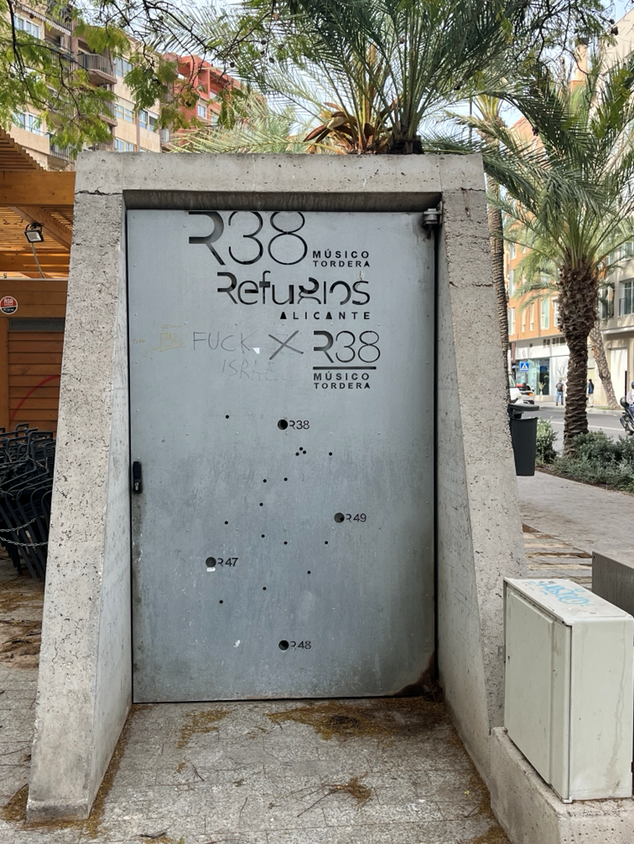
There is a small museum – the Centro de Interpretacion sobre los Refugios Antiaereos, which opens from this Spring, too late for us. But, as I discovered, it’s not too hard to spot many of the shelters; all numbered and most of them concreted, with steel doors.

I feel bad about coming to these issues so late in my life and career. Reading Dannie Abse’s Ash on a Young Man’s Sleeve and writing critiques of that great poet’s work, of course I had followed through on the associations of the scene where the young boy is taken to the memorial service for a fallen International Brigade volunteer, “Jimmy Ford”, who had died at the battle of Brunete. He was, in fact, Sammy Morris from Ammanford. “The Fifteenth Brigade, ragtime idealists, advance; but Jimmy Ford lay horizontal, akimbo, on the dusty road near the tobacco fields, the vision of a white, deserted farmhouse leaking out of his surprised eyes.”

Much later, my friend and mentor Dannie had mentioned the influence of Miguel Hernandez, but I had not followed up on that. There is a selected poems still available from Bloodaxe Books. Apparently, well translated and, certainly, generous in its scope; Hernandez lived a short life. As a writer he was relatively untutored, but lauded, a sort of Spanish John Clare. The War put him on the right side of history and he gave poetry readings and wrote a play to support the Republican cause. He was well-reviewed and could have expected a literary career. However, the Nationalists caught up with him; he was badly beaten and at one point he was condemned to death. Other writers campaigned for a reprieve and he could have stayed on the run, but he returned to Orihuela, his family, capture and, inevitably, death in the prison hospital in Alicante.

I am an open window, waiting

as life goes darkly by.

Yet there is a streak of sunlight in battle

which always leaves the shadow vanquished.


The late Hywel Francis did extensive research into the role of south Wales miners in the International Brigade; some 200 volunteered and served; 35 died. His father had been an active supporter of the cause in the coalfield.  It was no easy task to make it to Spain – clandestine train journeys as “tourists” to Paris and then being smuggled down south to the border. Francis’s Miners against Fascism: Wales and the Spanish Civil War (Lawrence and Wishart, 2012) is the standard reference text. And the poet John Ormond’s BBC Wales documentary series “The Miners’s Crusade”, first broadcast in 1979, has important footage and interviews. The narrative is there if we but look for it.

There are first-hand accounts by Edwin Greening, From Aberdare to Albacete and From the Rhondda to the Ebro, by Alun Menai Williams, both published by Warren & Pell. In 2022 First Minister Mark Drakeford unveiled a plaque on the Pierhead Building in Cardiff Bay; It commemorates  Captain Archibald Dickson from Roath, who bravely rescued some two thousand souls from the Alicante shore. A delegation from Alicante attended. And the International Brigade Cymru – (ibcymru is on Facebook) keeps the memory of those from Wales who served. Each summer they have a commemorative event at the Alexandra Gardens in central Cardiff. This year is the 90th anniversary of the start of the war and on Sunday, June 28th at 11.am. there will be a gathering at the memorial. I keep meaning to go: this year I will.

Alicante: Shelter R38


Between our apartment and the busy roads that cross

beneath us is a triangular little park with children’s swings,

benches, mothers and prams, old men, the Refugios38 entrance,

and a coffee cart that has breakfast pastries.

It is an oasis in the city’s hustle and traffic –

between Poeta Carmelo Calvo and Benito Pérez Galdos.


This is a short walk from the Central Market,

where in 1938, one May morning such as this,

the Aviazione Legionaria bombed the shoppers.

The market clock is kept at 11.20 to commemorate the act.

The Italians flew over Monte Tossal and with no sirens warning

nearly four hundred women and children were killed.


Alicante was the final post of the shrunken and defeated Republican cause.

In the bay where now the moneyed yachts are moored

the last comrades watched for ships that never came.

Except Captain Dickson’s The Stanbrook, dangerously crammed,

which got through the blockade to Algeria, to Oran

where the French would not let them land.


Those who remained, fifteen thousand men,

huddled in the sun, laid down their rifles in the sand

and prepared for what they knew would come.

Some committed suicide rather than face Franco’s hatred.

Two Anarchists vowed to shoot each other in the head.

They fell as one. Then the strafing began.


The survivors were marched to a camp in Albatera,

where they were beaten and selected for execution.

Franco ploughed it up after it had served its purpose.

There’s a recent memorial of sorts – two posts

with barbed wire strung between them and a plaque.

No directions are given: a contested history is hidden.


And on the last morning of our holiday, the air warms,

the Mercardo Central is bustling, the traffic speeds past our park,

where children are pushed on the swings

or fall asleep in the shade of the palms.

Captain Dickson, from Cardiff, has a bust on the harbour walk.

The steel door of R38 is graffitied Fuck Israel.


The Venice Biennale 2019

The Venice Biennale 2019

Full article and pictures on Wales Arts Review July 2019


In the first week of June I visited this year’s Venice Art Biennale, which runs fom the 11th of May to the 24th of November. The curator is Englishman Ralph Rugoff and he has chosen the title “May You Live in Interesting Times”. As always there is a bewildering display of contemporary art from many countries as well as concurrent commercial and individual artists showing new work in a wide variety of venues, from vacant shops to de-commisssioned churches, and in some of the grandest and most prestigious Palazzos and churches in the city. This is the most comprehensive exposure of international contemporary art in a context of some of the most beautiful buildings and Old Master artworks of the European tradition. This year is the fifty-eighth such event and is focussed on the Arsenale, the former ship-building areas on which the naval power of Venice was based, and the formal and traditional “pavilions” of the original determining nations from a hundrd and twenty years ago in the Giardino.

For the last four biennales Wales has been situated in the  Chiesi Santa Maria Ausiliatrice at the end of the Via Garibaldi close to the Arsenale. Whilst this location is more central than the previous – a former brewery on the Giudecca – there are constrictions in terms of the size and number of the rooms. Each artist must also decide how to screen off or incorporate the altar painting. Sean Edwards has brought the altar work into his piece,as the question of Catholicism and his mother’s background in Northern Ireland proves central to his theme.


In fact, his autobiographical exploration and celebration of his working class upbringing in the Llanederyn district of Cardiff is the subject of his installation. As shown in my photograph, the altar may only be approached through a web of curved wood splints, each bearing text or partial images. In one room four commissioned quilts hang, with a bound collection of Edwards’s blurred, black and white photographs of Llanederyn thrown on the floor. In another a period tv monitor shows dominoes being played (on the day we visited, this had broken down and we were told that “an engineer was flying over from Wales to fix it.”). In yet another room  Nails (or Inheriting Absence) is a large photograph of the artist’s finger nails bitten nervously to the quick.

In two further rooms there are speakers through which at two o’clock every afternoon Edwards’s mother broadcasts a reading of the same twenty minute script written by the artist. This last contribution is facilitated by  National Theatre Wales, but seems close to pointless. The script does not vary, is at times, stilted, and over the six months of the Biennale poor Mrs Edwards must surely tire of the whole exercise. Unless, of course, it really is a recording and that artifice is part of the piece. The screens and quilts have a repeating pattern of UN,UN or M,M. to represent the two tabloids which determined the news aspect of working class life in the Edwards household: the Sun was strictly forbidden and the Mirror was the source of true news.

On one wall is a framed poster which reads: “Free School Dinners”. This is given more resonance by the fact that the children from the nursery school attached to the rear of the building have to access the shared toilet through this room. In a way, they become part of the installation. Sean Edwards may be said to have answered the challenge of the Chiesi, but, as with many autobiographical works, one is left feeling that the conjunction of artefacts and art is loose and arbitrary. I am of an earlier generation, and part of the apparently respectable aspirant working classes in west Wales, but my engagement with working class life in north Cardiff will owe more to the witty and irreverent autobiographical novel The Vegetarian Tigers of Paradise by Crystal Jeans, than to this installation in Venice.

About the offical British pavilion there is litte to add to the poor press response: Cathy Wilkes has installed strange and unengaging pot-bellied figures amidst strewn furniture and objects: this cannot be her strongest work. Neither is the video by Turner Prize winner  Charlotte Prodger who shows in a disused boat yard just a short walk from Sean Edwards. This is the official Scotland showing. Prodger’s work continues to address lesbian and gender issues with SaFo5 taking its title from a lioness with a mane (and therefore, it is claimed, gender issues) rarely filmed in Botswana. Questions of gender, sexuality, queerness and the survival of the planet are very evident in this Biennale: art may no longer feel it has to mimetically represent our life in the world, but it invitably reflects the concerns we feel we must address, or are told that we ought to address.

Of the other official pavilions at Giardini, the USA has a strong showing by sculptor Martin Puryear and Canada’s pavilion has a compelling Inuit collective produced film “One Day in the Life of Noah Piugattuk” dramatising the threat to traditional ways of the first nation’s lives.

Art as paintings and sculpture reflecting the world are strongly represented this year, but mainly in the major buildings of Venice and parallel to the Biennale. For example, in the Jewish Museum in the Ghetto the ceramic artist Edmund de Waal, prize-winning author of The Hare With Amber Eyes,  has installed “Psalm” a series of his small and delicate porcelaine vessels. His work is extremely minimalist (see the cabinet in the National Museum of  Wales) but seems apt for the tragic context of the world’s first ghetto.


Perhaps the most prestigious of the locations outside the actual Biennale is the Church of San Georgio Maggiore on an island just opposite St Mark’s Square and the Doge’s Place. Sean Scully, claimed as an American in the accompanying catalogue, is arguably the most successful living British painter. He has been given the major space of this church in which to exhibit this year and, like Anish Kapoor before him has chosen a monumental sculpture for the nave. His column of coloured canvas blocks is so big that you are encouraged to walk inside and view the  sky through the church’s dome. Scully also has numerous sketchbooks, notes and fourteen paintings on show. At his best he has the mystery and power to engage the viewer in the manner of Mark Rothko. There is too a very rare figurative work – a triptych of his family on the beach in the Bahamas – blocks of colour within strong lines.

Sean Scully’s “window within a Window”.


A retrospective of the comparatively neglected painter Helen Frankenhaler was organised by the Gargosian gallery in the Palazzo Grimani. A contemporary of Pollack, de Kooning and Warhol, her Abstract Expressionist works sing their poetry wonderfully in this context. It is a reminder of long-standing gender inequalities in the arts.

In the magnificence of the Palazzo Grassi which at the last Biennale hosted Damion Hirst’s critically slated Treasures from the Wreck of the Unbelievable we are on safer ground this year with a retrospective of the significant Belgian painter Luc Tuymans – “La Pelle”. In over seventy painting he prods and challenges us into unsettling situations and interrogates the history of the last century. Here is his “Schwarzheide” laid as a marble re-flooring in the Palazzo; it reproduces a drawing from Alfred Kantor, a concentration camp survivor who smuggled out his art work.

Then, as one walks over the mosaic, through the columns  and up the stairs one is faced by “Secrets” a 1990 portrait of the Nazi Albert Speer.


The Palazzo Mora on the Strada Nuova over its several floors always has a rich assembly of artists, from the tiny atoll nation of Kiribati which is imminently threatened by rising seas – “Pacific Time/ Time Passes” – to established artists such as Daniel Pesta from the Czech Republic whose video “The Chain”  satirises the ritualistic practices of secret business cabals as one by one a group of men sets fire to each other’s arms. It is powerful and I hope it will be more widely available on the web, as is his earlier work.


In the Ca’D’Oro was “Dysfunctional”, works by eighteen contemporary artists, one of which was this witty Brexit piece positioned in front of a Van de Velde sea-scape. This magnificent palace on the Grand Canal always juxtaposes contemporary art in a provocative way with its traditional paintings and sculptures.


Venice has, of course, its own concerns about sinking and on our second day there the city was again threatened by the absurdly large liners which belly their way down the Grand Canal on their Med. and Adriatic cruises. The MSC Opera  crashed into a smaller river cruiser and one of the annual Venice regattas had to be cancelled as a consequence. Immediately the arguments for limiting visitor numbers and banning large ships from the city were again voiced. The turbulence of their powerful engines may be eroding the foundations of the building along the Grand Canal; certainly, from the cocktail terrace of the Molino Stucky hotel on the Guidecca their size outlined against the palaces of Venice is disturbing. Two days later, on June 4th, protest posters appeared on the streets and protest marches took place that weekend.


The view from the Molino Stucky Hotel.

Even more profoundly disturbing was the inclusion in the Biennale of this ship. She is propped on the side of a quay in the Arsenale as a holed and rusting hulk. The Swiss-Icelandic artist Cristoph Buchel was responsible for this and it has proved hugely contentious. This fishing vessel was wrecked with anything up to a thousand migrants on board. Buchel negotiated the challenges of ownership and legitimacy to move the boat from a naval base in Sicily for this exhibition. There it stands; you have to walk past it to complete the showings at the Arsenale; there is no title and no mention of the artist and no context. It is very chilling and takes to a new level the concept of interventions and the appropriation of the object brought into a gallery world. We’ve come a long way from Marcel Duchamp’s urinal.

Elsewhere in the winding ancient ship-building workshops of the Arsenale there are both individual artists on show as well as some nationally sponsored exhibits. Eva Rothschild shows for Ireland and her sculptural arrangements are always unsettling. I entered into the spirit of her humour and answered the challenge of the Irish custodian to climb up the blocks of apparently degrading plastic which formed one of the three pieces on show.  Venice makes you  move out of your comfort zone.


At the beginning of the very long Arsenale walk is Ed Atkins’s installation “Old Food” – clothes hanging, drawings and videos which includes the very witty video of bizarre sandwiches being assembled and then dissipated. Sauce covers bodies and faces and toy figures and, in one instance, the Union Flag; Brexit as a hash-up again. Atkins is a 37 year old lecturer at Goldsmith’s; evidently a rising star, and his fascination with “the suck and bloom of death and decay” is compelling. As are the Black News video installations of updated and period African American newsreels fixed in a backdrop panel of First World War Black GI recipients of the Croix de Guerre. This by  Kahlil Joseph – “BLKNWS” 2018 and ongoing…


In the cloisters of the Madonna del Orto, Tintoretto’s local church in the Cannaregio district where we were staying, is showing the work of Nic Fiddlen Green, the English sculptor whose characteristic horse’s head drinking is now a feature at Hyde Park Corner.There are over a dozen heads exhibited here, as well as drawings, etchings and two simple cruxifixes. It is difficult to imagine a more apt context for these works; they complement the church and its remarkable Tintorettoes, including the magnificent “The Virgin Being Presented to the Temple” of 1550.


The Madonna del Orto and its Cloisters.

The Madonna del Orto


This, the “English Church”, and its cloisters was immediately next door to our apartment. In Venice in a Biennale year or otherwise, you are always living with art.


American Visit 2015

A poet gets face-to-face with Andrew Wyeth’s world

09/21/2015 03:03PM, Published by J. Chambless, Categories:  NewsArts+EntertainmentToday

2

Welsh poet Tony Curtis with ‘Roasted Chestnuts’ by Andrew Wyeth at the Brandywine River Museum of Art.

By John Chambless
Staff Writer

Welsh poet Tony Curtis has long been an admirer of Andrew Wyeth, but until Sept. 21, he had never visited the Brandywine River Museum of Art, in the heart of Chadds Ford, where Wyeth spent his life creating landmark works of art.

Just before noon on Monday, Curtis – who read from his poems at an afternoon program at the museum – was standing in the midst of “Natural Selections,” a show of sketches of plants by Wyeth, and getting some insight from Virginia O’Hara, the curator of collections at the museum.

Curtis, who has published more than 30 books, including eight collections of poetry, had seen Wyeth’s works in several traveling exhibitions, beginning in 1980. But Monday was a feast of riches, beginning with guided tours of the galleries and a private behind-the-scenes look at the museum’s art storage area, and culminating with a tour of Andrew Wyeth’s studio.

“By accident, in the 1970s, my wife and I ended up in a babysitting group with an artist and his wife. We didn’t know much about art at all,” Curtis said. “But he lent me a Wyeth book. I responded to the intrigue, the narrative, the drama of Andrew Wyeth, as much as anything. When you actually see the work, you realize that the technique is there. This is a Renaissance master, in a sense. But first of all, the initial hook is the drama of the stuff.”

Years ago, for an American edition of one of his collections of poetry, Curtis thought that using Wyeth’s “Winter 1946” for the cover would be wonderful. So he took the direct approach and wrote a letter to the artist.

“Apparently, it wasn’t that common for him to allow people to use his works on covers,” Curtis said. “I don’t know – I just naively asked. Some obscure Welshman said, ‘Can we use this?’ and he agreed. I didn’t realize it was such a big deal.”

Wyeth had read the author’s poems before agreeing to let the art be used.

“He said some very nice things,” Curtis said. “He told me, ‘Rarely have I been so touched by a book of poems.’ Now, either he was being super-polite, which is an American flaw which we British don’t share,” Curtis added with a grin, “or I think he really did like them.”

Curtis writes elegantly about many subjects, but his seven Wyeth meditations are as sparing and precise as Wyeth’s paintings. The artist clearly felt strongly enough about the poems to allow his highly personal painting to be used.

The letters Curtis exchanged with Wyeth are now in the collection of the museum. He donated them when he came to present the reading on Monday. “I realized I should bring them here,” he said.

Moving into the large Andrew Wyeth Gallery at the museum, Curtis had a satisfied smile as he immersed himself in the monumental “Snow Hill” and the enigmatic “Spring” (1978), which depicts Wyeth’s dying neighbor, Karl Kuerner, seeming to appear out of the frozen earth. “Now, talk me through his one,” Curtis asked O’Hara, listening intently to the explanation. “It’s a very strange painting,” Curtis said. “It’s like he’s coming out of the freezer or something. Remarkable.”

Catching sight of “Spring Fed,” Curtis gasped. The painting of an overspilling water trough and barn window is the subject of one of his masterful poems, also titled “Spring Fed”:

The stone basin

fills and fills

from the swivel tap’s

trickle.


The hills have shed

so much snow

and now,

the first brown grasses

clear of it,

the heifers push

up into the fields

to take the early shoots.


And it comes

again

the whole slow

turning of the season –

the softer touch of air,

the shine on the bucket,

the unclenching of things,

the lapping of the water

in the stone basin

up to the rim,

and the very first,

this

delicious overspilling

onto our boots.


Curtis saw “Spring Fed” when it was part of a traveling exhibition at the Royal Academy of Arts, but still marvels at it. “It’s about nothing, in a sense,” he said. “It’s just this insignificant corner, but it’s about so much more.”

During his tour, Curtis asked about some of the people pictured in Wyeth’s portraits – such as James Loper, famously captured in Wyeth’s 1952 painting, and learned what details are known about the many people who sat for Wyeth.

Curtis had a special connection not only to Andrew Wyeth, but also Betsy Wyeth. Mary Landa, the collection manager of the Andrew Wyeth Office at the museum, asked to take a photo of Curtis with the portrait of Betsy, titled “Maga’s Daughter,” that hangs in the Wyeth Gallery. “She wanted me to send her a photo,” Landa said.

Spending a day engulfed in all things Wyeth, Curtis was genial, enthusiastic and awestruck by turns. Standing in the place where the artwork he admires is so firmly rooted, Curtis drew a comparison between what he does and what Wyeth did.

“I make a living out of teaching poetry, and one of the things I do is say that poets and artists both do the same thing,” he said. “Each of us starts with a blank rectangle. And we choose which bits we need to fill.”