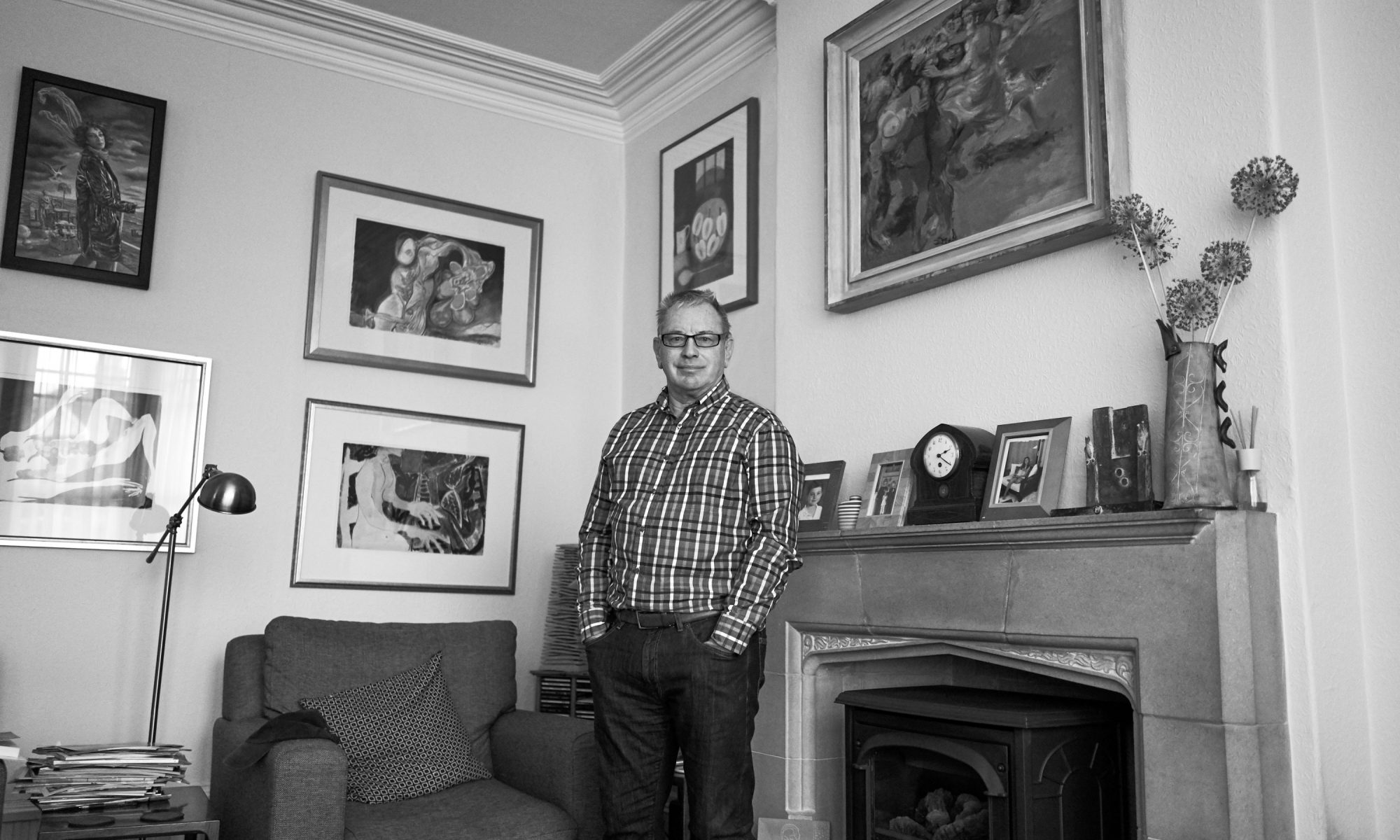
Tony Curtis storytelling Live, filmed at Cowbridge Library in late January 2025. Filmed & edited by waffle LLP
Venice Biennale Article 2019
Venice Biennale 2019 article
Venice Biennale 2019 article
Darkness in the City of Light – a novel
Professor Tony Curtis continues to give a series of talks about his novel, published in November, 2021 by Seren Books, which is receiving enthusiastic reviews.
This is a Powerpoint presentation- 50 mins with questions to follow.

Contact Tony Curtis – profcurtis@btinternet.com 07789182790
www.tonycurtispoet.com for further biographical information and list of publications
The ‘city of light’ under German occupation: Paris, a place, a people, lives in flux. And among these uncertainties, these compromised loyalties, these existences under constant threat, lives Marcel Petiot, a serial murderer. A doctor, a resistance fighter, a collaborator: who can tell? Not even the people he kills.
Petiot is the embodiment of the chaos and brutality of war, of the evil and inhumanity of dictatorship. With the liberation of Paris, Petiot is forced into new roles and new conspiracies to avoid trial and the guillotine.
Truth and fiction blur fundamentally, plausibility is tested, answers are few and questions multiply. Morality is more sharply in focus than ever, and more expendable. Stretching backwards and forwards through the twentieth century, this remarkable multi-form novel combines fiction, journals, poetry and images in its investigation of what war can let loose, and how evil can dominate a man.
&
 Dr Marcel Petiot in his trial, 1946
World War Two Paris brilliantly brought to life through the eyes of a range of characters – AMAZON
&
“Darkness in the City of Light is a genre-defying new novel by Tony Curtis” – David Lewellyn reviewing the book in Nation Cymru
“It is a vivid, kaleidoscopic portrait of Paris before, during and immediately after its liberation. We encounter Nazis in the full grip of hubris, the gallows humour of cabaret performers in the city’s seedier nightclubs, and witnesses to Ernest Hemingway and Fred Astaire at the Ritz.
If Petiot isn’t our main character, then Paris certainly is, and Curtis paints a picture of it, much like the city itself, in various shades of grey, a character it maintained decades after its Nazi occupiers became the stuff of history books and movies. As the horrific events of November 2015 and the Notre-Dame fire of 2019 remind us, there is still much darkness in the City of Light.”
&
Will I be the first to call it a tour de force? I won’t be the last. It is a highly readable novel, and a splendid union of documentation and imaginative reconstruction, as well as a convincing rendering of different voices. I was enthralled, and full of admiration for your art. – Professor Jeremy Hooker
&
WALES ARTS REVIEW – Nathan Munday
For better or for worse, what happens in war, stays in war. Does it? No. Tony Curtis’s thrilling new novel, Darkness in the City of Light, doesn’t shy away from the idea of ‘evil’ and ‘darkness’ seeping out of that period of flexible morality. Its Tableaux Parisiens is a genre-defying survey of a fissiparous city whose inhabitants ‘move in the shadows’. This is a city where the Gestapo are always ‘a few streets away’, where nothing is ‘my business’, and where ‘cries of help in the distance’ are repeatedly ignored. Many of these shadows never see light again especially after entering a certain ‘house in the Sixteenth’. Everyone seems to take these stories ‘with a pinch of salt’. After all, ‘what can you believe these days?’ is a recurring mantra running through the novel.
Curtis cleverly curates this documentary on paper. Weaving poetry with prose, he reveals the limits of language, showing us how different fonts changes the way we look at a story or the way in which we view its speakers. There are Holocaust allusions throughout making its Parisian setting microcosmic.
Darkness in the City of Light is an important book which gives a voice to the voiceless, yes, but it also shows how quickly things can go awry. Seren deserves praise for its book design and for recognising the importance of these experimental, multi-form novels which challenge conventional boundaries. I hope that many more poets will follow Curtis’s example.
&

A novel of intrigue and complexity…..it’s a haunting picture, one where horrors and graphic cruelty are juxtaposed with beauty that is created by people either in their small acts of kindness or their grand acts of art and bravery. – Yvette Vaughan Jones in Planet Magazine.
&
YORKSHIRE TIMES April 2022 arts
Clearing Up the Havoc: Darkness In The City Of Light By Tony Curtis
If you stand at the end of the raised platform of the Trocadero, and look down over the parapet to view the manicured gardens that lead to the Eiffel Tower, you might not be aware that you’re following more or less in the footsteps of Adolf Hitler. Flanked, on a June day in 1940, by his architect Albert Speer and Arno Breker, the Reich’s sculptor in chief, the Fuhrer surveyed the hitherto biggest prize in his conquistadorial career, from an entirely symbolic vantage point. Not one to waste an opportunity to bask in the reflected glory of victory and the subjugation of an old enemy, we needn’t doubt his choice of location in the dead heart of Paris, just as we shouldn’t be surprised at the signing of the terms of French surrender in the same railway carriage at Compiègne wherein the Treaty of Versailles was ratified in 1918.
…Curtis’ greatest triumph in a book of wonderful, authentically-rendered prose testimonies, is realised during the liberation of Paris…
Taken from a position somewhere below, and directly before, the Tower, the cover image of Tony Curtis’ absorbing new novel echoes that same sense of hubris. And the collective grievance that was rendered incendiary by the Nazi occupation and liberation of France, is one of the motors for Curtis’ foray into the internecine madness that followed. Relying heavily on an astonishing wealth of research, Curtis’ book rejects conventional narrative forms in favour of a patchwork assembly of contemporary ‘witness’ statements and observations which build to create a near-dystopian picture of a city in turmoil. The ‘talking heads’ emerge from several sides of a divide whose border is rendered necessarily fluid: complicated ethically, and sometimes judicially, by the presence of Vichy collaborators, the Gestapo on every street corner, the Resistance, and the lumpen populace who find themselves trapped in a maelstrom of contradiction and general anxiety, Curtis’ complex landscape turns increasingly dark and violent.
For several years Petiot practices his murderous campaign with impunity, proclaiming outrage at the suggestion of improbity, and he remains elusive, even unto the guillotine.
The poet and novelist’s glossary of the significant players in the dramatis personae reads like a Revolutionary Directoire, for the excess of fratricidal bloodletting cannot fail to recall that earlier round of implosive insanity. The mercurial, deluded figure of Marcel Petiot, upon whom the narrative hinges, represents the extremity of madness, the debased level to which human nature may stoop when obliged into penury and dependence by the Wehrmacht and their Parisian administrative puppets. Petiot is Conrad’s Kurtz, a maverick Svengali who dispenses justice according to his own rules, and murders and maims with the tacit approval of both sides: as a ‘doctor’ working patriotically in behalf of the Resistance, and as an emissary of the Third Reich, exposing their underground activities to the secret services. For several years Petiot practices his murderous campaign with impunity, proclaiming outrage at the suggestion of improbity, and he remains elusive, even unto the guillotine. The circling of Petiot continues unabated throughout Curtis’ multi-layered story – the narrative’s trajectory observes a linear chronology, but is shadowed by another history, tracing causes and familial consequences – and if Petiot’s lies are unconvincing, his condition is a symptom of, and metaphor for, a much wider existential malaise.
And that terrible inferno is drawn with perspicacious skill, giving vent to each arc as it intersects with, or diverges from, its inflammatory opposite: the German Officer whose proclivities bespeak cognitive dissonance as though it were a commonplace; the ‘decadent’ Jewish artists and musicians who are shipped off to the ‘departure lounge’ of Drancy for processing and onward transmission to Ravensbruck or Auschwitz; the British soldiers who pick up the postwar pieces; and lastly the pitiless ‘good doctor’, Petiot himself, who’s self-proclaimed medical training convinces many of his veracity.
But Curtis’ greatest triumph in a book of wonderful, authentically-rendered prose testimonies, is realised during the liberation of Paris: the release valve of celebration, as enjoined in the hubristic outpourings of writers, artists and war photographers who flock to the city, borders on self-indulgent lunacy; the definitive meaning of their actions is best conferred in the tranquility of hindsight. Not least in the figure of the swaggering Ernest Hemingway, who takes to the adulation of the streets like a god to grateful shadows:
“Hemingway arrived like a loud storm. Bourbon, cigars, a box
of grenades ‘A present for my friend Picasso’. The next day he
presented me with what was left of an SS uniform he said he’d
from the body of a Boche he’d killed. A story teller”.
Curtis’ tableau is both preposterous and narcotic. The carnival of seduced picaresques who foregather in the bars and hotels of the capital – Picasso, Philby, Orwell, Lee Miller, Dietrich, Chevalier – is symptomatic, also, of a landscape of naked extremities. Samuel Beckett’s fragmented reading of a dominion of waste is pivotal to a narrative of war, of religious corruption, of decay and renewal:
“Post-war St Lô …the sudden scurry of rats
above my head
in the ruins of everything…
and the necessary damage of war…
…rats, impervious to bombing it would appear
not the bodies they feed on…
it is a system of cycle nothing goes
to waste at this time but time
clearing up the havoc…”
The end, for Petiot, is as psychopathically defiant as the absurdity of his self-belief is unwavering. A fitting conclusion to the hideous deformity of a life, the drama of Madame Guillotine demands the cleanest of breaks, if only to draw a line under a complex and troublous past. The ‘goodnight kiss’ she delivers signifies a sleep before a better day.
Tony Curtis’ fine novel is a synthesis of negotiated truths, a harmonising of belief from many disparate testimonies, and it is to his huge credit that the picture he paints is both disturbing, and coherent.
Darkness in the City of Light – A Novel is published by Seren.
More information here: https://www.serenbooks.com/productdisplay/darkness-city-light
&
The ‘city of light’ under German occupation: Paris, a place, a people, lives in flux. And among these uncertainties, these compromised loyalties, these existences under constant threat, lives Marcel Petiot, a mass murderer. A doctor, a resistance fighter, a collaborator: who can tell? Not even the people he kills.
Petiot is the embodiment of the chaos and brutality of war, of the evil and inhumanity of dictatorship. With the liberation of Paris, Petiot is forced into new roles and new conspiracies to avoid trial and the guillotine.
Truth and fiction blur fundamentally, plausibility is tested, answers are few and questions multiply. Morality is more sharply in focus than ever, and more expendable. Stretching backwards and forwards through the twentieth century, this remarkable multi-form novel combines fiction, journals, poetry and images in its investigation of what war can let loose, and how evil can dominate a man.
Paris and this novel have a fascinating range of characters – Pablo Picasso, Ernest Hemingway, Coco Chanel, Maurice Chevalier, Malcolm Muggeridge, Churchill and de Gaulle.
Meeting Donald Hall
Meeting Donald Hall
Be careful what you throw out. After moving house, we have had to cut back on books and paintings. But I came close to discarding one of those thin, handsome American collections of poems you think you’ve finished with. Donald Hall’s 1978 collection Kicking the Leaves took me back to my two years at Goddard College, Vermont and the MFA course to which I flew over for residencies at the beginning and end of each of four semesters. When I graduated in 1981, I found myself in possession of one of the only formal Creative Writing degrees in the UK. The MA/M.Phil. course at my university, Glamorgan (later the University of South Wales) was what I was able to introduce and develop as a consequence of that MFA.
For Tony
in the wilds of Goddard
Donald Hall
late in January, 1979, I think.
Kicking the Leaves was published by Harper Row and like many collections of that time has a fine art quality which few could match in the UK. The cover has a photograph of the poet’s ancestors posed in front of their New Hampshire farmhouse, where the family had lived and farmed since the beginning of the nineteenth century. It is dedicated to Donald’s younger wife, the poet Jane Kenyan. She would die, aged forty-seven, in 1995. Donald Hall took years to come to terms with that loss, but poetry and prose writing would sustain him. They had met at the University of Michigan where Hall had been on the faculty and Jane had been a student. When he taught me at Goddard, he had left to be a full-time writer and they had moved to Wilmot in New Hampshire. She was New Hampshire’s Poet Laureate when she died.
 The Goddard faculty was exceptional – Hall, Ellen Bryant Voigt, Robert Hass, Heather McHugh, Thomas Lux, Stephen Dobyns and the 2020 Nobel Prize winner, Louise Gluck. Guest speakers included Richard Ford and Ray Carver. Writing workshops were small and challenging. Donald Hall fitted my concept of an American poet – large, bearded, with a strong voice and strong opinions. He was wise and eloquent. He had studied at Harvard and Oxford. He had met Eliot, Pound and as a sixteen-year -old, he had studied with Robert Frost at the Bread Loaf Writers Conference in Vermont. “I felt light in head and body. Merely seeing this man, merely laying startled eyes upon him, allowed me to feel enlarged. My dreams for my own life, for my own ageing into stone, took reality in the stern flesh of Robert Frost, who rose out of a hill in Vermont.”
Donald Hall met Frost on many occasions, including shortly before the old man’s death. The stern flesh and sharp tongue of the most famous living poet in America would inspire and alarm Hall. It was Frost, together with Robert Browning, who had been the models for my own dramatic monologues from the mid-eighties. I pushed on further when one of my Goddard critique assignments had brought Norman Dubie into focus.
Kicking the Leaves is such a strong collection: the title poem, “Eating the pig” and “The Names of Horses” are evocative narratives rooted in his family’s rural life, but reaching forward into our world. Here is “Names of Horses”:
One October the man, who fed you and kept you and harnessed
you every morning,
led you through corn stubble to sandy ground above Eagle Pond,
and dug a hole beside you where you stood shuddering in your
skin,
and lay the shotgun’s muzzle in the boneless hollow behind your
ear,
and fired the slug into your brain, and felled you into your grave,
shoveling sand to cover you, setting goldenrod upright above you,
where by next summer a dent in the ground made your monument.
Did I read right through this collection back in 1979? I cannot remember: surely, I would have absorbed the voice, stance and emotional heft of these poems. Did they inform my own work? How could one not try to emulate “shuddering in your skin”?
As part of the MFA I bought, read and critiqued a dozen or more (mainly) American books each semester; dutifully posted with my own poems in draft to my tutor for that term. Donald Hall was not a tutor of mine, but Stephen Dobyns, Thomas Lux and Jane Shore were. Stephen and Thomas were a couple of years older than me, Jane was actually younger, but her first collection, Eye Level, had won the Juniper Prize and she had studied with Elizabeth Bishop in Radcliffe College. She was a rising star.

My cohort included Mark Doty and Robert Long. Both would go on to become lauded poets, especially in the years of AIDS which followed through the 1980s and beyond. In my study clear-out, I also came across a photograph of them which I must have taken. Apart from my student ID card there is no photograph of me at Goddard: I was under everyone’s radar.
Along with Kicking the Leaves I bought Hall’s collection of essays and reviews, Goatfoot, Milkwood, Twinbird which had been published by the University of Michigan Press the year before. It’s a disparate collection of quirky, partial wisdoms. In the final piece he writes,” I remember Vernon Watkins telling me, years ago, that all a poet’s poems derived from one experience. The statement bewildered me then, and I believe it now.” I could not have read the book to its end, for I, too, was bewildered and inspired by Vernon Watkins when I had tutorials with him as an undergraduate in Swansea. I would have mentioned that to Donald Hall: the marginal, solitary Brit at Goddard was in need of all the kudos he could muster.
Folded inside my copy of Kicking the Leaves were two ruled pages of notes from a ring binder. At least now I can share some of the notes I scribbled at Donald Hall’s classes and from his writings:
*
“The pseudo-Pindaric is a helluva lot of fun. Though there are other ways of counting – word counts (Marianne Moore and Auden) prosaic, but controlled – accentuated counts, counting ‘loud’ noises (Coleridge’s “Christabel”) – how much this is used depends on a belief in the absolute measure of a sound.”
“The narrow cell within which Pope paced out his life: five steps up and five steps back – two important words each side of the caesura. Now this has to be balanced in all sorts of verse writing, from equal balance to infinitesimal, on the fourth, fifth or sixth syllable.”
“William Carlos Williams’s ‘the red wheelbarrow’ is all to do with line-structure. Free verse has to partake of a magic structure of its own. Read it through as a sentence – loving and loud. It is visually connecting… control and thought. The poem is intensifying by its visual shape.”
“Robert Frost’s’ ‘After Apple Picking’ works with varied-length lines in iambics. A poem is intensifying by its visual shape.”
“…pitch, volume and duration…expectation and variation… an iambic pentameter always has five feet, but there are different ways of getting there.”
“There is a need for structure and magic form – wisdom through shape – reading with the whole body.”
“I intend a poem after I write it: I intend by not crossing out.”
“Poems get taught as puzzles to which the answer is prose; the intellectual rather than the sensual.”
[Eliot, Pound, Frost and Dylan Thomas] all these men felt that their lives were a matter of their daily consideration, that their life’s work was, at each point in time, breaking against the shore of the moment.”
“Dream is the spirit dying into the underworld, and being born again.”
“The finished poem makes the noise of the lid closing on a perfectly-shaped box” – Yeats.
*
Donald Hall would go on to become the US Poet Laureate in 2006, though the strain of that role and its expectations blocked his poems for a few years. He then had a late blossoming and, in his eighties, wrote more prose, including Essays After Eighty, and some poems. He was eighty-seven when he died, a decade older than I am now. The mature, wise poet of my time at Goddard was only fifty-two. He died in a hospice, not in the painted marital bed in the farmhouse at Eagle Pond, as he’d wished. Ageing and house-bound, he looked out at the maple tree which is on the cover of Kicking the Leaves forty years before. The weather, the birds and the passing cars led to a late volume, Out of the Window. So, Vernon Watkins, whom we both met, was right; of course, it was that one experience.
The World Wide Web and the ubiquity of information were in no-one’s dreams in the late seventies when I was at Goddard and having to post my air mail letters and poems across the pond. Now we can all meet and enjoy Donald Hall:
https://www.newyorker.com/books/page-turner/donald-halls-late-burst-of-creativity
https://www.theatlantic.com › archive › 2018/06 › remembering Donald Hall: a poet of love and loss.
YouTube has an interview: “Old age is a ceremony of losses”.
Poem Hunter and Poetry Foundation are among several sites to feature his work.
There are copies of Kicking the Leaves for sale online. AbeBooks has a signed copy for $75.
Tony Curtis
Where the Birds sing Our Names
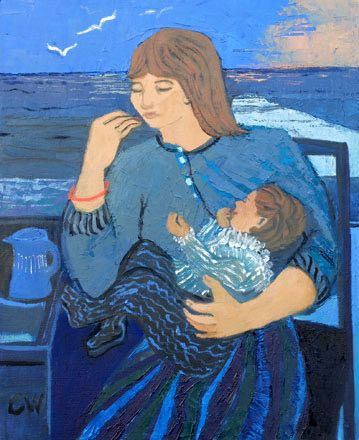
Where the Birds Sing Our Names
An Anthology for Ty Hafan
Edited by Tony Curtis
Seren Books 2021
Foreword: The Baroness Finlay of Llandaff
This beautiful gentle anthology awakens memories, some long since buried in one’s soul the happiest of childhood days of the celebration of each wonderful moment from conception through a toddler’s first steps and all the family dynamics of life. the simplest of encounters depth and beauty. Perhaps it is their transient nature that makes them more beautiful and yet this is only with hindsight that we really appreciate what has gone before.
The range of poems in this anthology allows the reader to find the few words that say so much, fitting each occasion. Tony Curtis has compiled a little treasure in this book, selecting poems to bring calm warmth to the reader.
Now more than ever we are all acutely aware of the fragility of precious life and how the protective love for a child transcends all other pressures.
It is a tribute to Ty Hafan that so many eminent poets have contributed to this book. This anthology enriches the reader, reminding us of our infinite capacity to feel and share emotion, away from yet sometimes mixed in with the precious and routines of daily life. This is a book to be savoured and enjoyed.
Ilora Finlay
In December 2021 Tony introduced and read from his Ty Hafan charity anthology – Where the Birds sing Our Names.
Click the link below to view the video on Facebook:
https://www.facebook.com/hugh.bird.14/videos/627816688637338/
Recording by the river Thaw in Cowbridge- filmed by Hugh Bird.
Where the birds sing our names
When the children pass on
Their names are put into Morse Code, dot and dash,
And the parents choose a song-bird –
Robin, blackbird, wren and thrush –
These name-notes are played as you pass each tree
In the woods around Ty Hafan, the house-haven.
Bird sings to bird across the land,
A chain of notes until the trees end
And the oceans begin. Then they fly beyond.
So imitative birds pass on these name-notes of song
Against the murmurings of the sea:
Some kind of immortality.
The Venice Biennale 2019
The Venice Biennale 2019
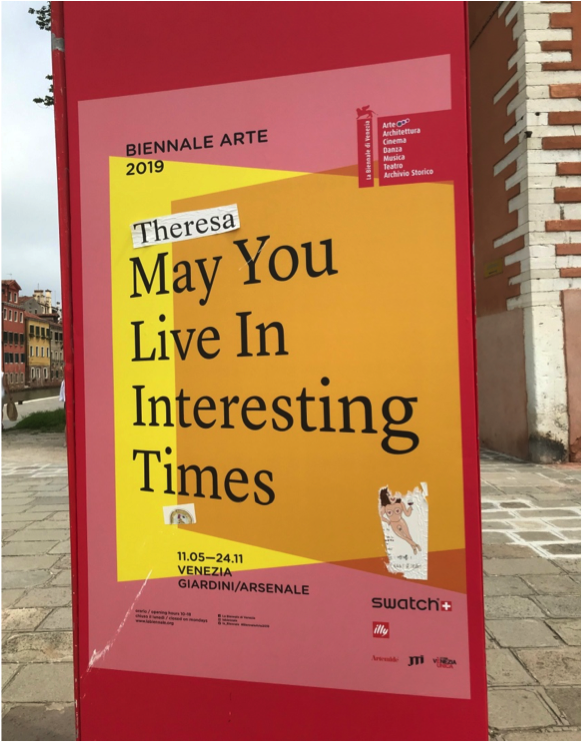
In the first week of June I visited this year’s Venice Art Biennale, which runs fom the 11th of May to the 24th of November. The curator is Englishman Ralph Rugoff and he has chosen the title “May You Live in Interesting Times”. As always there is a bewildering display of contemporary art from many countries as well as concurrent commercial and individual artists showing new work in a wide variety of venues, from vacant shops to de-commisssioned churches, and in some of the grandest and most prestigious Palazzos and churches in the city. This is the most comprehensive exposure of international contemporary art in a context of some of the most beautiful buildings and Old Master artworks of the European tradition. This year is the fifty-eighth such event and is focussed on the Arsenale, the former ship-building areas on which the naval power of Venice was based, and the formal and traditional “pavilions” of the original determining nations from a hundrd and twenty years ago in the Giardino.
For the last four biennales Wales has been situated in the Chiesi Santa Maria Ausiliatrice at the end of the Via Garibaldi close to the Arsenale. Whilst this location is more central than the previous – a former brewery on the Giudecca – there are constrictions in terms of the size and number of the rooms. Each artist must also decide how to screen off or incorporate the altar painting. Sean Edwards has brought the altar work into his piece,as the question of Catholicism and his mother’s background in Northern Ireland proves central to his theme.

In fact, his autobiographical exploration and celebration of his working class upbringing in the Llanederyn district of Cardiff is the subject of his installation. As shown in my photograph, the altar may only be approached through a web of curved wood splints, each bearing text or partial images. In one room four commissioned quilts hang, with a bound collection of Edwards’s blurred, black and white photographs of Llanederyn thrown on the floor. In another a period tv monitor shows dominoes being played (on the day we visited, this had broken down and we were told that “an engineer was flying over from Wales to fix it.”). In yet another room Nails (or Inheriting Absence) is a large photograph of the artist’s finger nails bitten nervously to the quick.
In two further rooms there are speakers through which at two o’clock every afternoon Edwards’s mother broadcasts a reading of the same twenty minute script written by the artist. This last contribution is facilitated by National Theatre Wales, but seems close to pointless. The script does not vary, is at times, stilted, and over the six months of the Biennale poor Mrs Edwards must surely tire of the whole exercise. Unless, of course, it really is a recording and that artifice is part of the piece. The screens and quilts have a repeating pattern of UN,UN or M,M. to represent the two tabloids which determined the news aspect of working class life in the Edwards household: the Sun was strictly forbidden and the Mirror was the source of true news.
On one wall is a framed poster which reads: “Free School Dinners”. This is given more resonance by the fact that the children from the nursery school attached to the rear of the building have to access the shared toilet through this room. In a way, they become part of the installation. Sean Edwards may be said to have answered the challenge of the Chiesi, but, as with many autobiographical works, one is left feeling that the conjunction of artefacts and art is loose and arbitrary. I am of an earlier generation, and part of the apparently respectable aspirant working classes in west Wales, but my engagement with working class life in north Cardiff will owe more to the witty and irreverent autobiographical novel The Vegetarian Tigers of Paradise by Crystal Jeans, than to this installation in Venice.
About the offical British pavilion there is litte to add to the poor press response: Cathy Wilkes has installed strange and unengaging pot-bellied figures amidst strewn furniture and objects: this cannot be her strongest work. Neither is the video by Turner Prize winner Charlotte Prodger who shows in a disused boat yard just a short walk from Sean Edwards. This is the official Scotland showing. Prodger’s work continues to address lesbian and gender issues with SaFo5 taking its title from a lioness with a mane (and therefore, it is claimed, gender issues) rarely filmed in Botswana. Questions of gender, sexuality, queerness and the survival of the planet are very evident in this Biennale: art may no longer feel it has to mimetically represent our life in the world, but it invitably reflects the concerns we feel we must address, or are told that we ought to address.
Of the other official pavilions at Giardini, the USA has a strong showing by sculptor Martin Puryear and Canada’s pavilion has a compelling Inuit collective produced film “One Day in the Life of Noah Piugattuk” dramatising the threat to traditional ways of the first nation’s lives.
Art as paintings and sculpture reflecting the world are strongly represented this year, but mainly in the major buildings of Venice and parallel to the Biennale. For example, in the Jewish Museum in the Ghetto the ceramic artist Edmund de Waal, prize-winning author of The Hare With Amber Eyes, has installed “Psalm” a series of his small and delicate porcelaine vessels. His work is extremely minimalist (see the cabinet in the National Museum of Wales) but seems apt for the tragic context of the world’s first ghetto.

Perhaps the most prestigious of the locations outside the actual Biennale is the Church of San Georgio Maggiore on an island just opposite St Mark’s Square and the Doge’s Place. Sean Scully, claimed as an American in the accompanying catalogue, is arguably the most successful living British painter. He has been given the major space of this church in which to exhibit this year and, like Anish Kapoor before him has chosen a monumental sculpture for the nave. His column of coloured canvas blocks is so big that you are encouraged to walk inside and view the sky through the church’s dome. Scully also has numerous sketchbooks, notes and fourteen paintings on show. At his best he has the mystery and power to engage the viewer in the manner of Mark Rothko. There is too a very rare figurative work – a triptych of his family on the beach in the Bahamas – blocks of colour within strong lines.
Sean Scully’s “window within a Window”.

A retrospective of the comparatively neglected painter Helen Frankenhaler was organised by the Gargosian gallery in the Palazzo Grimani. A contemporary of Pollack, de Kooning and Warhol, her Abstract Expressionist works sing their poetry wonderfully in this context. It is a reminder of long-standing gender inequalities in the arts.

In the magnificence of the Palazzo Grassi which at the last Biennale hosted Damion Hirst’s critically slated Treasures from the Wreck of the Unbelievable we are on safer ground this year with a retrospective of the significant Belgian painter Luc Tuymans – “La Pelle”. In over seventy painting he prods and challenges us into unsettling situations and interrogates the history of the last century. Here is his “Schwarzheide” laid as a marble re-flooring in the Palazzo; it reproduces a drawing from Alfred Kantor, a concentration camp survivor who smuggled out his art work.

Then, as one walks over the mosaic, through the columns and up the stairs one is faced by “Secrets” a 1990 portrait of the Nazi Albert Speer.
The Palazzo Mora on the Strada Nuova over its several floors always has a rich assembly of artists, from the tiny atoll nation of Kiribati which is imminently threatened by rising seas – “Pacific Time/ Time Passes” – to established artists such as Daniel Pesta from the Czech Republic whose video “The Chain” satirises the ritualistic practices of secret business cabals as one by one a group of men sets fire to each other’s arms. It is powerful and I hope it will be more widely available on the web, as is his earlier work.

In the Ca’D’Oro was “Dysfunctional”, works by eighteen contemporary artists, one of which was this witty Brexit piece positioned in front of a Van de Velde sea-scape. This magnificent palace on the Grand Canal always juxtaposes contemporary art in a provocative way with its traditional paintings and sculptures.

Venice has, of course, its own concerns about sinking and on our second day there the city was again threatened by the absurdly large liners which belly their way down the Grand Canal on their Med. and Adriatic cruises. The MSC Opera crashed into a smaller river cruiser and one of the annual Venice regattas had to be cancelled as a consequence. Immediately the arguments for limiting visitor numbers and banning large ships from the city were again voiced. The turbulence of their powerful engines may be eroding the foundations of the building along the Grand Canal; certainly, from the cocktail terrace of the Molino Stucky hotel on the Guidecca their size outlined against the palaces of Venice is disturbing. Two days later, on June 4th, protest posters appeared on the streets and protest marches took place that weekend.

The view from the Molino Stucky Hotel.
The MSC Opera

The “No Grandi Navi” posters.


Even more profoundly disturbing was the inclusion in the Biennale of this ship. She is propped on the side of a quay in the Arsenale as a holed and rusting hulk. The Swiss-Icelandic artist Cristoph Buchel was responsible for this and it has proved hugely contentious. This fishing vessel was wrecked with anything up to a thousand migrants on board. Buchel negotiated the challenges of ownership and legitimacy to move the boat from a naval base in Sicily for this exhibition. There it stands; you have to walk past it to complete the showings at the Arsenale; there is no title and no mention of the artist and no context. It is very chilling and takes to a new level the concept of interventions and the appropriation of the object brought into a gallery world. We’ve come a long way from Marcel Duchamp’s urinal.
Elsewhere in the winding ancient ship-building workshops of the Arsenale there are both individual artists on show as well as some nationally sponsored exhibits. Eva Rothschild shows for Ireland and her sculptural arrangements are always unsettling. I entered into the spirit of her humour and answered the challenge of the Irish custodian to climb up the blocks of apparently degrading plastic which formed one of the three pieces on show. Venice makes you move out of your comfort zone.

At the beginning of the very long Arsenale walk is Ed Atkins’s installation “Old Food” – clothes hanging, drawings and videos which includes the very witty video of bizarre sandwiches being assembled and then dissipated. Sauce covers bodies and faces and toy figures and, in one instance, the Union Flag; Brexit as a hash-up again. Atkins is a 37 year old lecturer at Goldsmith’s; evidently a rising star, and his fascination with “the suck and bloom of death and decay” is compelling. As are the Black News video installations of updated and period African American newsreels fixed in a backdrop panel of First World War Black GI recipients of the Croix de Guerre. This by Kahlil Joseph – “BLKNWS” 2018 and ongoing…

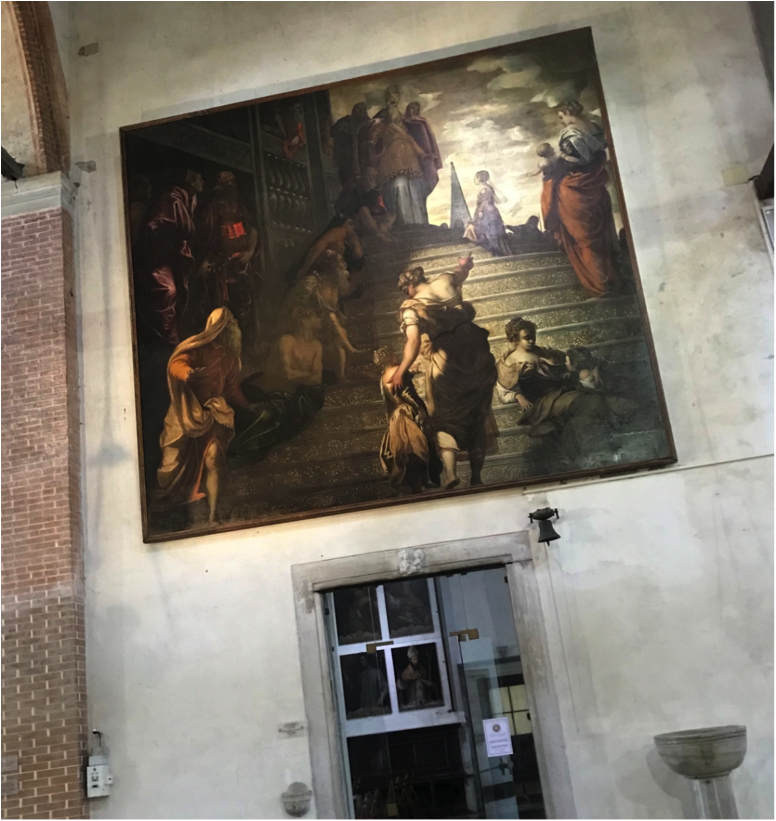
In the cloisters of the Madonna del Orto, Tintoretto’s local church in the Cannaregio district where we were staying, is showing the work of Nic Fiddlen Green, the English sculptor whose characteristic horse’s head drinking is now a feature at Hyde Park Corner.There are over a dozen heads exhibited here, as well as drawings, etchings and two simple cruxifixes. It is difficult to imagine a more apt context for these works; they complement the church and its remarkable Tintorettoes, including the magnificent “The Virgin Being Presented to the Temple” of 1550.
The Madonna del Orto and its Cloisters.

The Madonna del Orto
This, the “English Church”, and its cloisters was immediately next door to our apartment. In Venice in a Biennale year or otherwise, you are always living with art.
The Venice Biennale 2019
The Venice Biennale 2019
Full article and pictures on Wales Arts Review July 2019
In the first week of June I visited this year’s Venice Art Biennale, which runs fom the 11th of May to the 24th of November. The curator is Englishman Ralph Rugoff and he has chosen the title “May You Live in Interesting Times”. As always there is a bewildering display of contemporary art from many countries as well as concurrent commercial and individual artists showing new work in a wide variety of venues, from vacant shops to de-commisssioned churches, and in some of the grandest and most prestigious Palazzos and churches in the city. This is the most comprehensive exposure of international contemporary art in a context of some of the most beautiful buildings and Old Master artworks of the European tradition. This year is the fifty-eighth such event and is focussed on the Arsenale, the former ship-building areas on which the naval power of Venice was based, and the formal and traditional “pavilions” of the original determining nations from a hundrd and twenty years ago in the Giardino.
For the last four biennales Wales has been situated in the Chiesi Santa Maria Ausiliatrice at the end of the Via Garibaldi close to the Arsenale. Whilst this location is more central than the previous – a former brewery on the Giudecca – there are constrictions in terms of the size and number of the rooms. Each artist must also decide how to screen off or incorporate the altar painting. Sean Edwards has brought the altar work into his piece,as the question of Catholicism and his mother’s background in Northern Ireland proves central to his theme.
In fact, his autobiographical exploration and celebration of his working class upbringing in the Llanederyn district of Cardiff is the subject of his installation. As shown in my photograph, the altar may only be approached through a web of curved wood splints, each bearing text or partial images. In one room four commissioned quilts hang, with a bound collection of Edwards’s blurred, black and white photographs of Llanederyn thrown on the floor. In another a period tv monitor shows dominoes being played (on the day we visited, this had broken down and we were told that “an engineer was flying over from Wales to fix it.”). In yet another room Nails (or Inheriting Absence) is a large photograph of the artist’s finger nails bitten nervously to the quick.
In two further rooms there are speakers through which at two o’clock every afternoon Edwards’s mother broadcasts a reading of the same twenty minute script written by the artist. This last contribution is facilitated by National Theatre Wales, but seems close to pointless. The script does not vary, is at times, stilted, and over the six months of the Biennale poor Mrs Edwards must surely tire of the whole exercise. Unless, of course, it really is a recording and that artifice is part of the piece. The screens and quilts have a repeating pattern of UN,UN or M,M. to represent the two tabloids which determined the news aspect of working class life in the Edwards household: the Sun was strictly forbidden and the Mirror was the source of true news.
On one wall is a framed poster which reads: “Free School Dinners”. This is given more resonance by the fact that the children from the nursery school attached to the rear of the building have to access the shared toilet through this room. In a way, they become part of the installation. Sean Edwards may be said to have answered the challenge of the Chiesi, but, as with many autobiographical works, one is left feeling that the conjunction of artefacts and art is loose and arbitrary. I am of an earlier generation, and part of the apparently respectable aspirant working classes in west Wales, but my engagement with working class life in north Cardiff will owe more to the witty and irreverent autobiographical novel The Vegetarian Tigers of Paradise by Crystal Jeans, than to this installation in Venice.
About the offical British pavilion there is litte to add to the poor press response: Cathy Wilkes has installed strange and unengaging pot-bellied figures amidst strewn furniture and objects: this cannot be her strongest work. Neither is the video by Turner Prize winner Charlotte Prodger who shows in a disused boat yard just a short walk from Sean Edwards. This is the official Scotland showing. Prodger’s work continues to address lesbian and gender issues with SaFo5 taking its title from a lioness with a mane (and therefore, it is claimed, gender issues) rarely filmed in Botswana. Questions of gender, sexuality, queerness and the survival of the planet are very evident in this Biennale: art may no longer feel it has to mimetically represent our life in the world, but it invitably reflects the concerns we feel we must address, or are told that we ought to address.
Of the other official pavilions at Giardini, the USA has a strong showing by sculptor Martin Puryear and Canada’s pavilion has a compelling Inuit collective produced film “One Day in the Life of Noah Piugattuk” dramatising the threat to traditional ways of the first nation’s lives.
Art as paintings and sculpture reflecting the world are strongly represented this year, but mainly in the major buildings of Venice and parallel to the Biennale. For example, in the Jewish Museum in the Ghetto the ceramic artist Edmund de Waal, prize-winning author of The Hare With Amber Eyes, has installed “Psalm” a series of his small and delicate porcelaine vessels. His work is extremely minimalist (see the cabinet in the National Museum of Wales) but seems apt for the tragic context of the world’s first ghetto.
Perhaps the most prestigious of the locations outside the actual Biennale is the Church of San Georgio Maggiore on an island just opposite St Mark’s Square and the Doge’s Place. Sean Scully, claimed as an American in the accompanying catalogue, is arguably the most successful living British painter. He has been given the major space of this church in which to exhibit this year and, like Anish Kapoor before him has chosen a monumental sculpture for the nave. His column of coloured canvas blocks is so big that you are encouraged to walk inside and view the sky through the church’s dome. Scully also has numerous sketchbooks, notes and fourteen paintings on show. At his best he has the mystery and power to engage the viewer in the manner of Mark Rothko. There is too a very rare figurative work – a triptych of his family on the beach in the Bahamas – blocks of colour within strong lines.
Sean Scully’s “window within a Window”.
A retrospective of the comparatively neglected painter Helen Frankenhaler was organised by the Gargosian gallery in the Palazzo Grimani. A contemporary of Pollack, de Kooning and Warhol, her Abstract Expressionist works sing their poetry wonderfully in this context. It is a reminder of long-standing gender inequalities in the arts.
In the magnificence of the Palazzo Grassi which at the last Biennale hosted Damion Hirst’s critically slated Treasures from the Wreck of the Unbelievable we are on safer ground this year with a retrospective of the significant Belgian painter Luc Tuymans – “La Pelle”. In over seventy painting he prods and challenges us into unsettling situations and interrogates the history of the last century. Here is his “Schwarzheide” laid as a marble re-flooring in the Palazzo; it reproduces a drawing from Alfred Kantor, a concentration camp survivor who smuggled out his art work.
Then, as one walks over the mosaic, through the columns and up the stairs one is faced by “Secrets” a 1990 portrait of the Nazi Albert Speer.
The Palazzo Mora on the Strada Nuova over its several floors always has a rich assembly of artists, from the tiny atoll nation of Kiribati which is imminently threatened by rising seas – “Pacific Time/ Time Passes” – to established artists such as Daniel Pesta from the Czech Republic whose video “The Chain” satirises the ritualistic practices of secret business cabals as one by one a group of men sets fire to each other’s arms. It is powerful and I hope it will be more widely available on the web, as is his earlier work.
In the Ca’D’Oro was “Dysfunctional”, works by eighteen contemporary artists, one of which was this witty Brexit piece positioned in front of a Van de Velde sea-scape. This magnificent palace on the Grand Canal always juxtaposes contemporary art in a provocative way with its traditional paintings and sculptures.
Venice has, of course, its own concerns about sinking and on our second day there the city was again threatened by the absurdly large liners which belly their way down the Grand Canal on their Med. and Adriatic cruises. The MSC Opera crashed into a smaller river cruiser and one of the annual Venice regattas had to be cancelled as a consequence. Immediately the arguments for limiting visitor numbers and banning large ships from the city were again voiced. The turbulence of their powerful engines may be eroding the foundations of the building along the Grand Canal; certainly, from the cocktail terrace of the Molino Stucky hotel on the Guidecca their size outlined against the palaces of Venice is disturbing. Two days later, on June 4th, protest posters appeared on the streets and protest marches took place that weekend.
The view from the Molino Stucky Hotel.
Even more profoundly disturbing was the inclusion in the Biennale of this ship. She is propped on the side of a quay in the Arsenale as a holed and rusting hulk. The Swiss-Icelandic artist Cristoph Buchel was responsible for this and it has proved hugely contentious. This fishing vessel was wrecked with anything up to a thousand migrants on board. Buchel negotiated the challenges of ownership and legitimacy to move the boat from a naval base in Sicily for this exhibition. There it stands; you have to walk past it to complete the showings at the Arsenale; there is no title and no mention of the artist and no context. It is very chilling and takes to a new level the concept of interventions and the appropriation of the object brought into a gallery world. We’ve come a long way from Marcel Duchamp’s urinal.
Elsewhere in the winding ancient ship-building workshops of the Arsenale there are both individual artists on show as well as some nationally sponsored exhibits. Eva Rothschild shows for Ireland and her sculptural arrangements are always unsettling. I entered into the spirit of her humour and answered the challenge of the Irish custodian to climb up the blocks of apparently degrading plastic which formed one of the three pieces on show. Venice makes you move out of your comfort zone.
At the beginning of the very long Arsenale walk is Ed Atkins’s installation “Old Food” – clothes hanging, drawings and videos which includes the very witty video of bizarre sandwiches being assembled and then dissipated. Sauce covers bodies and faces and toy figures and, in one instance, the Union Flag; Brexit as a hash-up again. Atkins is a 37 year old lecturer at Goldsmith’s; evidently a rising star, and his fascination with “the suck and bloom of death and decay” is compelling. As are the Black News video installations of updated and period African American newsreels fixed in a backdrop panel of First World War Black GI recipients of the Croix de Guerre. This by Kahlil Joseph – “BLKNWS” 2018 and ongoing…
In the cloisters of the Madonna del Orto, Tintoretto’s local church in the Cannaregio district where we were staying, is showing the work of Nic Fiddlen Green, the English sculptor whose characteristic horse’s head drinking is now a feature at Hyde Park Corner.There are over a dozen heads exhibited here, as well as drawings, etchings and two simple cruxifixes. It is difficult to imagine a more apt context for these works; they complement the church and its remarkable Tintorettoes, including the magnificent “The Virgin Being Presented to the Temple” of 1550.
The Madonna del Orto and its Cloisters.
The Madonna del Orto
This, the “English Church”, and its cloisters was immediately next door to our apartment. In Venice in a Biennale year or otherwise, you are always living with art.
American Visit 2015
A poet gets face-to-face with Andrew Wyeth’s world
09/21/2015 03:03PM, Published by J. Chambless, Categories: News, Arts+Entertainment, Today
Welsh poet Tony Curtis with ‘Roasted Chestnuts’ by Andrew Wyeth at the Brandywine River Museum of Art.
By John Chambless
Staff Writer
Welsh poet Tony Curtis has long been an admirer of Andrew Wyeth, but until Sept. 21, he had never visited the Brandywine River Museum of Art, in the heart of Chadds Ford, where Wyeth spent his life creating landmark works of art.
Just before noon on Monday, Curtis – who read from his poems at an afternoon program at the museum – was standing in the midst of “Natural Selections,” a show of sketches of plants by Wyeth, and getting some insight from Virginia O’Hara, the curator of collections at the museum.
Curtis, who has published more than 30 books, including eight collections of poetry, had seen Wyeth’s works in several traveling exhibitions, beginning in 1980. But Monday was a feast of riches, beginning with guided tours of the galleries and a private behind-the-scenes look at the museum’s art storage area, and culminating with a tour of Andrew Wyeth’s studio.
“By accident, in the 1970s, my wife and I ended up in a babysitting group with an artist and his wife. We didn’t know much about art at all,” Curtis said. “But he lent me a Wyeth book. I responded to the intrigue, the narrative, the drama of Andrew Wyeth, as much as anything. When you actually see the work, you realize that the technique is there. This is a Renaissance master, in a sense. But first of all, the initial hook is the drama of the stuff.”
Years ago, for an American edition of one of his collections of poetry, Curtis thought that using Wyeth’s “Winter 1946” for the cover would be wonderful. So he took the direct approach and wrote a letter to the artist.
“Apparently, it wasn’t that common for him to allow people to use his works on covers,” Curtis said. “I don’t know – I just naively asked. Some obscure Welshman said, ‘Can we use this?’ and he agreed. I didn’t realize it was such a big deal.”
Wyeth had read the author’s poems before agreeing to let the art be used.
“He said some very nice things,” Curtis said. “He told me, ‘Rarely have I been so touched by a book of poems.’ Now, either he was being super-polite, which is an American flaw which we British don’t share,” Curtis added with a grin, “or I think he really did like them.”
Curtis writes elegantly about many subjects, but his seven Wyeth meditations are as sparing and precise as Wyeth’s paintings. The artist clearly felt strongly enough about the poems to allow his highly personal painting to be used.
The letters Curtis exchanged with Wyeth are now in the collection of the museum. He donated them when he came to present the reading on Monday. “I realized I should bring them here,” he said.
Moving into the large Andrew Wyeth Gallery at the museum, Curtis had a satisfied smile as he immersed himself in the monumental “Snow Hill” and the enigmatic “Spring” (1978), which depicts Wyeth’s dying neighbor, Karl Kuerner, seeming to appear out of the frozen earth. “Now, talk me through his one,” Curtis asked O’Hara, listening intently to the explanation. “It’s a very strange painting,” Curtis said. “It’s like he’s coming out of the freezer or something. Remarkable.”
Catching sight of “Spring Fed,” Curtis gasped. The painting of an overspilling water trough and barn window is the subject of one of his masterful poems, also titled “Spring Fed”:
The stone basin
fills and fills
from the swivel tap’s
trickle.
The hills have shed
so much snow
and now,
the first brown grasses
clear of it,
the heifers push
up into the fields
to take the early shoots.
And it comes
again
the whole slow
turning of the season –
the softer touch of air,
the shine on the bucket,
the unclenching of things,
the lapping of the water
in the stone basin
up to the rim,
and the very first,
this
delicious overspilling
onto our boots.
Curtis saw “Spring Fed” when it was part of a traveling exhibition at the Royal Academy of Arts, but still marvels at it. “It’s about nothing, in a sense,” he said. “It’s just this insignificant corner, but it’s about so much more.”
During his tour, Curtis asked about some of the people pictured in Wyeth’s portraits – such as James Loper, famously captured in Wyeth’s 1952 painting, and learned what details are known about the many people who sat for Wyeth.
Curtis had a special connection not only to Andrew Wyeth, but also Betsy Wyeth. Mary Landa, the collection manager of the Andrew Wyeth Office at the museum, asked to take a photo of Curtis with the portrait of Betsy, titled “Maga’s Daughter,” that hangs in the Wyeth Gallery. “She wanted me to send her a photo,” Landa said.
Spending a day engulfed in all things Wyeth, Curtis was genial, enthusiastic and awestruck by turns. Standing in the place where the artwork he admires is so firmly rooted, Curtis drew a comparison between what he does and what Wyeth did.
“I make a living out of teaching poetry, and one of the things I do is say that poets and artists both do the same thing,” he said. “Each of us starts with a blank rectangle. And we choose which bits we need to fill.”