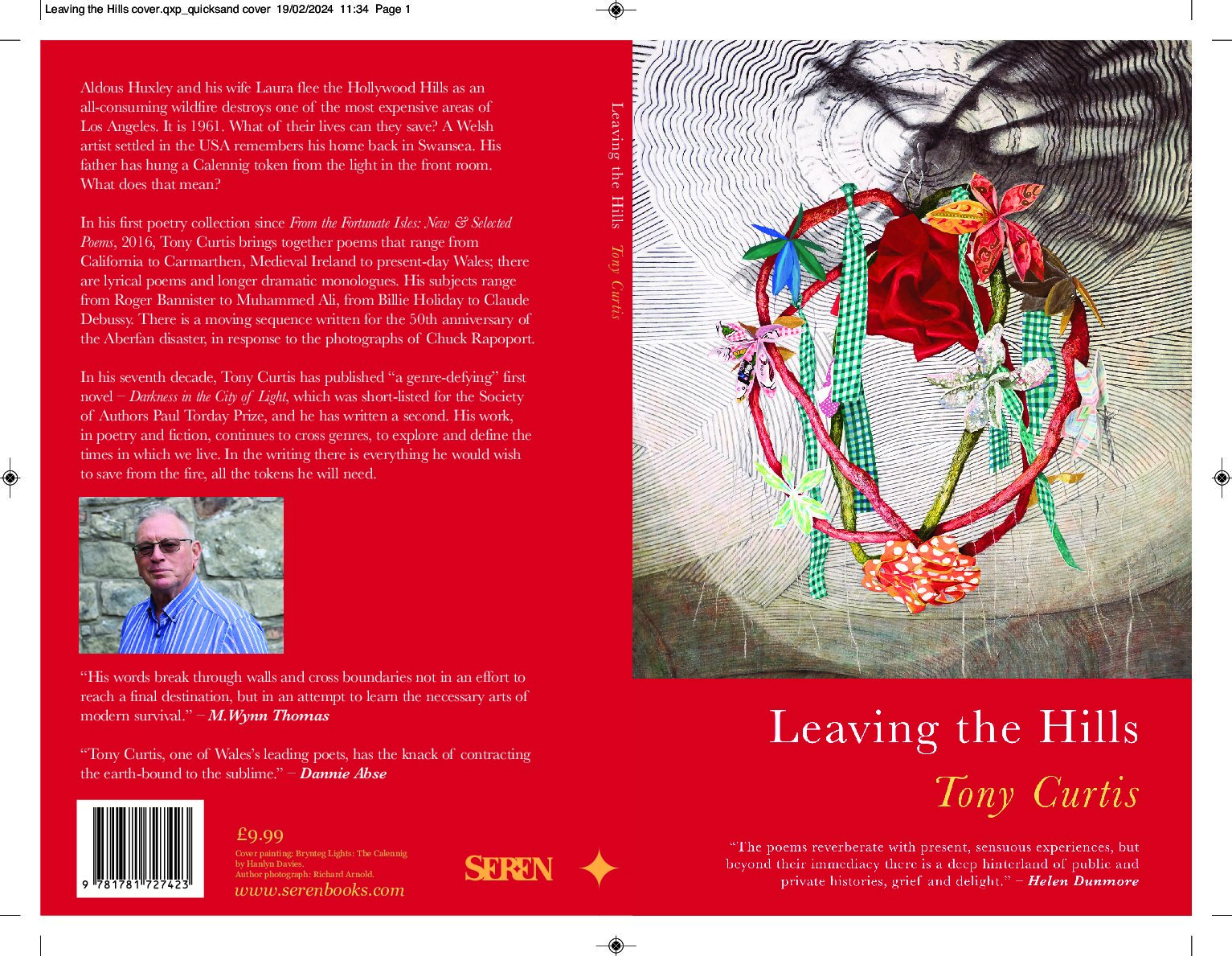
In 2024 Seren published his eleventh poetry collection Leaving the Hills. It was warmly received –
This wide-ranging collection sees Curtis writing at the height of his powers and confirms his position as one of Wales’s leading poets.
by Neil Leadbeater WRITEOUTLOUD
https://www.writeoutloud.net/public/blogentry.php?blogentryid=136366.
Tony Curtis’s Leaving the Hills is a collection that spans from the Welsh mountains to the Hollywood Hills, these poems offer lyrics, longer dramatic monologues and they explore personalities as various as Roger Bannister, Muhammed Ali, Billie Holiday, and Claude Debussy.
In his first poetry collection since From the Fortunate Isles: New & Selected Poems (2016), Curtis brings together poems that range from California to Carmarthen, Medieval Ireland to present-day Wales.
From the beginning, Curtis emphasizes the precariousness and urgency of modern life. In the title poem, Aldous Huxley and his wife Laura flee Hollywood as an all-consuming wildfire destroys one of the most expensive areas of Los Angeles. It is 1961. Leaving the Hollywood Hills, what of their lives can they save?
Later, Curtis explores a different set of hills: the south Wales valleys, as he writes about the photographs taken in the days after the 1966 Aberfan mining disaster by Life magazine photographer I.C. ‘Chuck’ Rapoport. In ‘Ready to Fly’, a child posed in black and white between two sacks of coal springs to life as a human being full of longings and dreams, recalling “the faces of the children” who died.
Curtis is an excellent writer of the lyric, his speakers moving thoughtfully through landscapes. In ‘The Guardian’, the narrator persists in the hopefulness of his daily routine, still believing he might see a trout in the water where one never has been, or in ‘Katie’s Hare’, the animal conjures a host of memories difficult to convey to his granddaughter.
Monologues also feature here, as well as poems about particular personalities or artists. ‘Claude and Chouchou at Le Moulleau, 1916’ explores the profound relationship of Claude Debussy and his daughter. Curtis also portrays a series of historical characters on trial for various crimes; Anne James, in C19th Pembrokeshire, charged for the supposed murder of her baby cuts a sympathetic figure, while the trial of David Evans recalls modern stories of violence against women, questioning how far we have progressed since these historical tales. Among other poems devoted to people, there is a striking sequence of poems for the Welsh artist Hanlyn Davies now based in New England, and a sequence of poems praising jazz musicians like Stan Getz, Billie Holiday, and ‘Brubeck at St David’s Hall’.
Ultimately, Leaving the Hills explores and defines the times in which we live. The title becomes a metaphor for that moment when we are forced to choose what to take and what to leave behind. Curtis chooses moments of brilliance, of epiphany, of knowledge and of vividness. In these poems, there is everything he would wish to save from the fire.
“His words break through walls and cross boundaries not in an effort to reach a final destination but in an attempt to learn the necessary arts of modern survival.” – Professor M. Wynn Thomas.
“Tony Curtis, one of Wales’s leading poets, has the knack of contracting the earth-bound to the sublime.” – Dannie Abse.
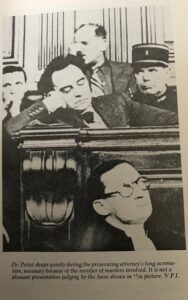
In October 2021 Seren published Tony’ book set in wartime Paris as the novel Darkness in the City of Light which concerns the Occupation and specifically the serial killer Dr Marcel Petiot.
In 2023 the novel was short-listed for the Society of Authors Paul Torday Prize.

Darkness in the City of Light, Seren Books
NATION CYMRU……CULTURE
Review: Darkness in the City of Light is a genre-defying new novel by Tony Curtis
David Llewellyn
The final days of the Third Reich have proven to be a rich seam of inspiration for writers and filmmakers in the decades since Hitler and his cohort exited the stage in a suicidal blaze of ignominy. Director G.W. Pabst, who had made two feature films under the regime, was the first to give us an onscreen “Fuhrer” in his 1955 film The Last Ten Days. It’s a story that’s been retold in versions featuring Alec Guinness, Anthony Hopkins, and – perhaps most successfully – Bruno Ganz as the murderous dictator.
A list of fictional and imaginative depictions of Nazism’s twilight might include Pasolini’s final and most controversial film Salo, or the 120 Days of Sodom, in which de Sade’s tale of depravity is transposed to the fascist puppet state in Northern Italy. In Gunter Grasse’s epic novel The Tin Drum the diminutive Oskar bears witness to the rise and inevitable fall of German fascism, while Hans Hellmut Kirst’s novel The Night of the Generals and its 1967 adaptation starring Peter O’Toole, has three generals suspected of murder meet in Paris in the summer of ’44, as the “Tausendjähriges Reich” loses its grip on its westernmost province.
It was in this real-life diabolical milieu that the crimes of Marcel Petiot came to light. Posing as the saviour of those who wished to escape Nazi-occupied Paris – the Jews, Resistance fighters and criminals facing internment and much worse – he was in fact a serial killer, responsible for perhaps as many as 60 murders, poisoning those who sought his assistance and keeping their money and belongings for himself.
When some of the victims’ bodies and belongings were found at a property belonging to him, Petiot’s defence was that he had been working with the Resistance, and that the bodies were those of traitors and collaborators. It was one he maintained right up until the end, but it convinced neither judge nor jury, and he was executed in May 1946.
Petiot, who went by various aliases, including Dr Eugene and Henri Valeri, is the focal point of Darkness in the City of Light, a genre-defying new novel by the poet Tony Curtis. This isn’t a simple retelling of the Petiot story, one that might sit comfortably on the True Crime or Holocaust-themed shelves of your local discount bookshop.
In breaking both moulds Curtis combines documentary elements with imaginary monologues, in prose and verse, and a cast of real-life characters, from famous names such as Picasso, Simone de Beauvoir and Lee Miller to the victims of Dr Petiot, who speak to the condemned man from beyond the grave during his final days and hours.
Deceit and disinformation
It was these verses I found most powerful, moments when the book touches most profoundly on the scale of the tragedy wrought by both Petiot and the genocidal regime that sent so many men, women and children to the internment camp at Drancy and finally the death camps of the east.
The doctor committed his crimes in an age of deceit and disinformation, surrounded by a cavalcade of crooks, murderers and thieves, both among the occupying forces and the local criminal underclass, and Curtis masterfully smudges the already blurred lines between fiction and fact.
A lesser book might have made an antihero of Petiot, but by giving voice to the witnesses and those who disappeared into the charnel house of 21 Rue le Sueur, Darkness in the City of Light often feels like a final act of restorative justice, long after Madame Guillotine meted out the judge’s sentence at Paris’s Prison de la Sante.
It is also a vivid, kaleidoscopic portrait of Paris before, during and immediately after its liberation. We encounter Nazis in the full grip of hubris, the gallows humour of cabaret performers in the city’s seedier nightclubs, and witnesses to Ernest Hemingway and Fred Astaire at the Ritz.
If Petiot isn’t our main character, then Paris certainly is, and Curtis paints a picture of it, much like the city itself, in various shades of grey, a character it maintained decades after its Nazi occupiers became the stuff of history books and movies. As the horrific events of November 2015 and the Notre-Dame fire of 2019 remind us, there is still much darkness in the City of Light.
YORKSHIRE POST April 2022 arts
Clearing Up the Havoc: Darkness In The City Of Light By Tony Curtis
If you stand at the end of the raised platform of the Trocadero, and look down over the parapet to view the manicured gardens that lead to the Eiffel Tower, you might not be aware that you’re following more or less in the footsteps of Adolf Hitler. Flanked, on a June day in 1940, by his architect Albert Speer and Arno Breker, the Reich’s sculptor in chief, the Fuhrer surveyed the hitherto biggest prize in his conquistadorial career, from an entirely symbolic vantage point. Not one to waste an opportunity to bask in the reflected glory of victory and the subjugation of an old enemy, we needn’t doubt his choice of location in the dead heart of Paris, just as we shouldn’t be surprised at the signing of the terms of French surrender in the same railway carriage at Compiègne wherein the Treaty of Versailles was ratified in 1918.
…Curtis’ greatest triumph in a book of wonderful, authentically-rendered prose testimonies, is realised during the liberation of Paris…
Taken from a position somewhere below, and directly before, the Tower, the cover image of Tony Curtis’ absorbing new novel echoes that same sense of hubris. And the collective grievance that was rendered incendiary by the Nazi occupation and liberation of France, is one of the motors for Curtis’ foray into the internecine madness that followed. Relying heavily on an astonishing wealth of research, Curtis’ book rejects conventional narrative forms in favour of a patchwork assembly of contemporary ‘witness’ statements and observations which build to create a near-dystopian picture of a city in turmoil. The ‘talking heads’ emerge from several sides of a divide whose border is rendered necessarily fluid: complicated ethically, and sometimes judicially, by the presence of Vichy collaborators, the Gestapo on every street corner, the Resistance, and the lumpen populace who find themselves trapped in a maelstrom of contradiction and general anxiety, Curtis’ complex landscape turns increasingly dark and violent.
For several years Petiot practices his murderous campaign with impunity, proclaiming outrage at the suggestion of improbity, and he remains elusive, even unto the guillotine.
The poet and novelist’s glossary of the significant players in the dramatis personae reads like a Revolutionary Directoire, for the excess of fratricidal bloodletting cannot fail to recall that earlier round of implosive insanity. The mercurial, deluded figure of Marcel Petiot, upon whom the narrative hinges, represents the extremity of madness, the debased level to which human nature may stoop when obliged into penury and dependence by the Wehrmacht and their Parisian administrative puppets. Petiot is Conrad’s Kurtz, a maverick Svengali who dispenses justice according to his own rules, and murders and maims with the tacit approval of both sides: as a ‘doctor’ working patriotically in behalf of the Resistance, and as an emissary of the Third Reich, exposing their underground activities to the secret services. For several years Petiot practices his murderous campaign with impunity, proclaiming outrage at the suggestion of improbity, and he remains elusive, even unto the guillotine. The circling of Petiot continues unabated throughout Curtis’ multi-layered story – the narrative’s trajectory observes a linear chronology, but is shadowed by another history, tracing causes and familial consequences – and if Petiot’s lies are unconvincing, his condition is a symptom of, and metaphor for, a much wider existential malaise.
And that terrible inferno is drawn with perspicacious skill, giving vent to each arc as it intersects with, or diverges from, its inflammatory opposite: the German Officer whose proclivities bespeak cognitive dissonance as though it were a commonplace; the ‘decadent’ Jewish artists and musicians who are shipped off to the ‘departure lounge’ of Drancy for processing and onward transmission to Ravensbruck or Auschwitz; the British soldiers who pick up the postwar pieces; and lastly the pitiless ‘good doctor’, Petiot himself, who’s self-proclaimed medical training convinces many of his veracity.
But Curtis’ greatest triumph in a book of wonderful, authentically-rendered prose testimonies, is realised during the liberation of Paris: the release valve of celebration, as enjoined in the hubristic outpourings of writers, artists and war photographers who flock to the city, borders on self-indulgent lunacy; the definitive meaning of their actions is best conferred in the tranquility of hindsight. Not least in the figure of the swaggering Ernest Hemingway, who takes to the adulation of the streets like a god to grateful shadows:
“Hemingway arrived like a loud storm. Bourbon, cigars, a box
of grenades ‘A present for my friend Picasso’. The next day he
presented me with what was left of an SS uniform he said he’d
from the body of a Boche he’d killed. A story teller”.
Curtis’ tableau is both preposterous and narcotic. The carnival of seduced picaresques who foregather in the bars and hotels of the capital – Picasso, Philby, Orwell, Lee Miller, Dietrich, Chevalier – is symptomatic, also, of a landscape of naked extremities. Samuel Beckett’s fragmented reading of a dominion of waste is pivotal to a narrative of war, of religious corruption, of decay and renewal:
“Post-war St Lô …the sudden scurry of rats
above my head
in the ruins of everything…
and the necessary damage of war…
…rats, impervious to bombing it would appear
not the bodies they feed on…
it is a system of cycle nothing goes
to waste at this time but time
clearing up the havoc…”
The end, for Petiot, is as psychopathically defiant as the absurdity of his self-belief is unwavering. A fitting conclusion to the hideous deformity of a life, the drama of Madame Guillotine demands the cleanest of breaks, if only to draw a line under a complex and troublous past. The ‘goodnight kiss’ she delivers signifies a sleep before a better day.
Tony Curtis’ fine novel is a synthesis of negotiated truths, a harmonising of belief from many disparate testimonies, and it is to his huge credit that the picture he paints is both disturbing, and coherent.
Darkness in the City of Light – A Novel is published by Seren.
More information here: https://www.serenbooks.com/productdisplay/darkness-city-light
&
The ‘city of light’ under German occupation: Paris, a place, a people, lives in flux. And among these uncertainties, these compromised loyalties, these existences under constant threat, lives Marcel Petiot, a mass murderer. A doctor, a resistance fighter, a collaborator: who can tell? Not even the people he kills.
Petiot is the embodiment of the chaos and brutality of war, of the evil and inhumanity of dictatorship. With the liberation of Paris, Petiot is forced into new roles and new conspiracies to avoid trial and the guillotine.
Truth and fiction blur fundamentally, plausibility is tested, answers are few and questions multiply. Morality is more sharply in focus than ever, and more expendable. Stretching backwards and forwards through the twentieth century, this remarkable multi-form novel combines fiction, journals, poetry and images in its investigation of what war can let loose, and how evil can dominate a man.
Paris and this novel have a fascinating range of characters – Pablo Picasso, Ernest Hemingway, Coco Chanel, Maurice Chevalier, Malcolm Muggeridge, Churchill and de Gaulle.
A Novel is published by Seren.
More information here: https://www.serenbooks.com/productdisplay/darkness-city-light
&
The ‘city of light’ under German occupation: Paris, a place, a people, lives in flux. And among these uncertainties, these compromised loyalties, these existences under constant threat, lives Marcel Petiot, a mass murderer. A doctor, a resistance fighter, a collaborator: who can tell? Not even the people he kills.
Petiot is the embodiment of the chaos and brutality of war, of the evil and inhumanity of dictatorship. With the liberation of Paris, Petiot is forced into new roles and new conspiracies to avoid trial and the guillotine.
Truth and fiction blur fundamentally, plausibility is tested, answers are few and questions multiply. Morality is more sharply in focus than ever, and more expendable. Stretching backwards and forwards through the twentieth century, this remarkable multi-form novel combines fiction, journals, poetry and images in its investigation of what war can let loose, and how evil can dominate a man.
Paris and this novel have a fascinating range of characters – Pablo Picasso, Ernest Hemingway, Coco Chanel, Maurice Chevalier, Malcolm Muggeridge, Churchill and de Gaulle.
Darkness in the City of Light by Tony Curtis is published by Seren Books and can be purchased here or at your local bookshop
Other Recent Books
 In the summer of 2021 Seren published Where the Birds Sing our Names, an anthology in support of the children’s hospice Ty Hafan in south Wales. Tony is the editor and originator of the project . All monies from this anthology go to the charity. It may be bought at any Ty Hafen shop or from their website.
www.tyhafen.org

From the Fortunate Isles: New & Selected Poems is, effectively, my tenth collection. It is my selection of those poems written since 1966 and my undergraduate days, through nine individual collections and several pamphlets, including collaborations with photographers and artists.

My early career was greatly assisted by a Gregory Award in 1972 which enabled me to go to the USA for first time. Poems written after that trip then won the Welsh Arts Council’s Young Poets Prize in 1974 and my first collection, Album, was published in that year. I had also moved back to Wales from teaching posts in England and had taken up my first college lecturing post. Seven of those early poems open the present selection, though of course, the later, more mature work forms the core of the book.
In the 1980s, following my MFA studies at Goddard College in Vermont (I was a contemporary of Mark Doty and worked with several leading American poets – Jane Shore, Stephen Dobyns and Thomas Lux) the work deepened and broadened and I had considerable success in the mid decade, winning the National Poetry Competition in 1984 and being short-listed for the Observer/Arvon Prize in 1985. Those poems represented a move from the confessional mode to take on the experiences and voices of others, moving across periods of history and voicing the experiences of both men and women. I had re-visited the poems of Browning and Frost from my early education and had re-read Robert Lowell and absorbed the startling work of the contemporary American Norman Dubie especially.
In 1986 Poetry Wales Press published my first Selected Poems and Story Line Press later that year published in the USA Poems Selected and New. The present book builds on and re-considers those selections so that the last thirty years are evenly and well represented. Poems, individually and collectively, were awarded the Dylan Thomas Prize in 1994, judged by Dannie Abse and Aeronwy Thomas, and a Cholmondley Award in 1997.
I trust that my mature work continues to address those concerns with language, empathy and moral engagement to which commentators and reviewers called attention. Certainly, the subjects of family, the history of the twentieth century, Wales, America and the visual arts persist to the present. The response which I hold most dear is that from the great American painter Andrew Wyeth, quoted on the American Selected Poems and on this book’s cover. In September 2015 I took our original correspondence to the Brandywine Wyeth Museum in Pennsylvania and gave a reading of my Wyeth poems. “Andrew Wyeth’s Snow Hill”, one of the later poems in this selection was written after that visit. Artist friends – Charles Burton, Brendan Burns, David Nash, Alan Salisbury – have been important supporters. The 1986 Selected Poems had an Alan Salisbury painting as its cover and I delighted to have a new painting by him on the cover of this latest book.
In my little memoir My Life With Dylan Thomas (Mulfran Press, 2014) I said that Dylan was like a mountain, you had to go over him or around, you couldn’t ignore him. Any writer from Wales of his or my generation had to recognize that. In common with my great friend and mentor Dannie Abse I had to work through those “loud echoes” of the bard of Cwmdonkin. Dannie’s work and example were central to my writing as were other poets I met and learned from – Leslie Norris, Seamus Heaney, George Macbeth – and my colleagues at the university, among them Gillian Clarke. In my seventieth year to heaven I remain committed to developing my poetry in its scope and focus. Although my selected short stories are to be published by Cinnamon Press in May 2017 and I shall take great pleasure in that, poetry has always been at the core of my writing and my professional life: when I was awarded a personal chair by the University of Glamorgan in 1994 I became Professor of Poetry; it seemed to be the most appropriate title.
Often it is the reading of contemporary poetry that stirs me into action and leads me to new poems – Robin Robertson, Michael Longley, Paul Muldoon, John Burnside, Don Paterson, David Harsent, George Szirtes. They say: Listen to us – what have you still got to say?
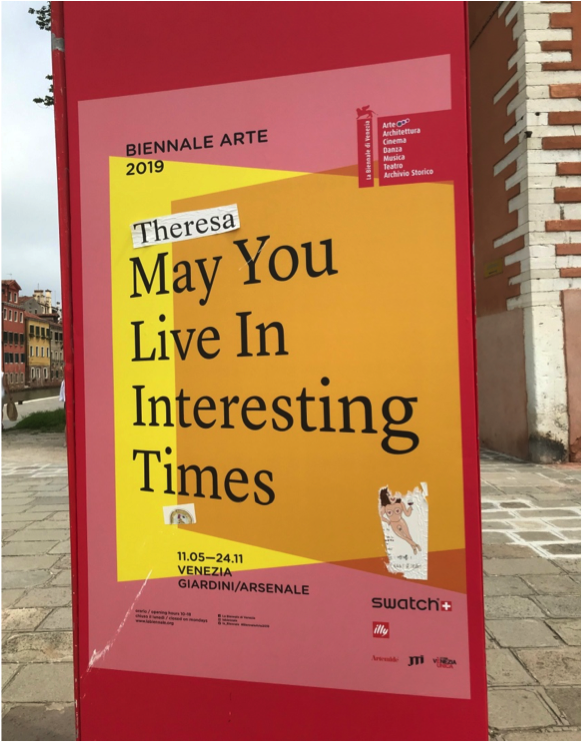
If it is clear that the central themes of my work have remained –Wales, family, art, war – then it should also be seen that these themes are often interrelated and inform each other: poems should talk across collections. So a poem such as “Mapping the World” from Crossing Over, whilst begins on a visit to the Venice Biennale becomes another praise poem for the landscape of Wales. A visit to the Waterloo battleground leads to a celebration of David Jones. Needing to celebrate Dannie Abse’s long life leads to a consideration of other old masters of art and music. Among the considerable group of war poems stretching over four decades comes a later “Pro Patria” which re-considers my relationship with my father and my childhood, subjects from which I felt I’d had to move away in the early eighties following his death. The confessional poems, especially from Preparations, had created a body of work which I was finding too difficult to read in public. In the early eighties, when I had a number of critical successes, I had moved into a strategy of voicing the experiences of others, now through researching family history I was drawn back to a confessional challenge: my father’s sketchy narrative of his war had proven to be a fiction. The involvement of my family in the conflicts of the twentieth century has taken another twist. It is that possibility of surprise and challenge which keeps me writing as a poet, alongside my other work and which underlines the fact that I am essentially a poet and would not wish it to be otherwise.
If there is a sad fall in the final poems of this selection, the new poems, it is, I hope, not terminal. This poet is only posing as a old man; seventy is the new fifty, and the man across from you on the Tube is not waving, not drowning, not mumbling, but singing, “carrying the music of it through our lives”.
POETRY WALES REVIEW BY JEREMY HOOKER:
Tony Curtis From The Fortunate Isles: New & Selected Poems (Seren, £12. 99)
Tony Curtis: Poet as Painter From the Fortunate Isles,
Tony Curtis’s New & Selected Poems, published to celebrate his 70th birthday, is an ample, various collection. As well as a number of powerful long poems (with long titles), such as ‘The Death of Richard Beattie-Seaman in the Belgian Grand Prix, 1939’, it includes poems such as ‘Letting Go’ which have a delicate lyricism. The epigraph to one poem quotes Dannie Abse: ‘I start with the visible and am startled by the visible’. Curtis too is a highly visual poet. He has a passion for painting – the book contains numerous poems about painters, such as Andrew Wyeth, Graham Sutherland, Gwen John and Ernest Zobole – but his art is more than a picturing. As his poetry develops from an early interest in the photographic, it acquires a rich verbal texture, analogous to vigorous brushstrokes and the expressive density of impasto. He is a muscular poet, as he has described Peter Prendergast as ‘a muscular painter’.
As in the work of painters he admires, Curtis’s seeing becomes the making of aesthetic objects. Tony Conran, in Frontiers in Anglo-Welsh Poetry, said of Curtis: he ‘aims at tragedy. He dares to attempt the vast tragic themes of our times’. The truth of this is borne out by numerous poems about the world wars of the twentieth century, the Holocaust, and other crimes against humanity. From Auden to Ted Hughes and Jon Silkin generations of British poets have been haunted by the wars of the fathers, in which they themselves were too young to fight. Curtis, too, is an appalled witness after the event. He knows that he is living his life on ‘the Fortunate Isles’, with a responsibility to respect and enter sympathetically into the experience of those who have been less fortunate.
In dealing with other people’s experience, Curtis often adopts or constructs ‘voices’ based on written records. It is a technique also used by Roland Mathias and Ruth Bidgood, and it represents the sense of history belonging to the generation of Anglophone Welsh poets with whom Curtis has close affinities. As well as Mathias and Bidgood, these include Abse, Glyn Jones and John Tripp. It is a family resemblance, but what Curtis has to offer is all his own. The epigraph to another poem, ‘Pembrokeshire Seams’, quotes Gwyn A. Williams’s famous affirmation of the construction of Welshness which includes the words: ‘Wales is an artefact which the Welsh produce’. In ‘Thoughts from the Holiday Inn’, his long poem addressed to John Tripp, Curtis writes:
How arbitrary one’s identity is: with voice and gesture we are challenged to make sense of where and what we find ourselves.
Curtis is a well-travelled poet – he has written a number of poems set in North America, for example – but the where for him is principally south and west Wales, and the what consists in large part of his people – the Welsh people, and, most intimately, family and ancestry. As in ‘Under the Yew’, a poem about visiting his grandmother’s grave, he is a poet of strong, loving emotion for whom ‘the string is tied back here, as they say –/apron strings, heart strings, a way through the maze’. Far from being a poet of arbitrary identity, a man lost in a maze, Curtis is firmly attached to the familial land of Wales. This sense of attachment has a bearing on what he makes of his painterly imagination. It relates to the muscularity, the transformative energy, which works against melancholia and the potential despair of his often-grim subject matter. He depicts a material world, which he describes in ‘Letting Go’:
The world is plant and animal –
it melts, it dies, it falls.
The following line reads: ‘So we make of it art’. Against the downward drag of his sense of mortality, Curtis lifts his spirits (and the reader’s) with his celebration of the aesthetic sense. As I implied earlier, this involves more than a love of painterly surfaces. It has a moral dimension, in art’s capacity to collaborate with cruelty, as shown in ‘William Orpen & Yvonne Aubicq in the Rue Dannon’. More often, Curtis depicts the positive relationship between artistic making and experience, with which painter and poet establish a place in the world. ‘Quartet for Two Painters’ provides a good example. The first part, ‘Prendergast’s Quarry’, is an elegy for Peter Prendergast, which ends:
In your last wicker bed
you lie, Peter, and one by one
we sprinkle our fingers of earth on you.
You chose this landscape and it takes you in.
The tone is properly elegiac, a tribute to a dead friend. But the lines say more than that the painter is buried in the earth of north Wales. The language of the poem – the impasto effect I referred to earlier – depicts a landscape seen in terms of the painter’s art, so that ‘takes you in’ suggests a sense of deep belonging. In choosing the landscape, Prendergast helped to ‘make’ it, to render it as imaginative vision. This is what Curtis’s poetry at its best does.
Another fine example is ‘Lines at Barry’. Like many of Curtis’s poems, this is compact with history. Beginning ‘Morning light steely and sharp on the docks-water’, the poem describes ‘your greatgrandfather’s vision’ as, an emigrant, he arrived in South Wales in 1898. The story of the poem – ‘not a unique story’ – relates the subsequent family experience to the larger history, and concludes:
Three lifetimes, two wars running to this moment –
and none of this is unique, this telling,
this drawing from memory of lines
where, steely-silver, what we are now
touches everything that made us,
and is dangerous, and shines.
The surface realism of the poem contains a richly metaphorical use of the word ‘lines’. This is at once compositional – the ‘lines’ of the poem – and suggestive of other meanings, such as sight-lines and life-lines and lines in which people stand, or march. This is poet’s work, which shows an affinity to the art of certain painters. Its object is the disclosure of meaning in a depth of human experience, visible in and below history’s many dark or colourful surfaces.
———————————————————————————————–
Some Kind of Immortality
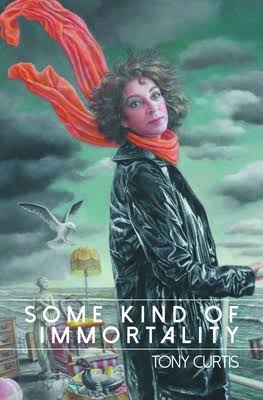
This was, effectively, my selected stories, with work from the last forty years and much more recent work. Many of these stories have been published and/or broadcast. Cinnamon Press no longer have copies available. They are culpable in the book’s unavailability and the poet no longer has any involvement with this press.
My Life with Dylan Thomas

Tony Curtis was born in Carmarthen in 1946 and so for seven years shared that town with Dylan Thomas, his family and friends, for whom it was the main railway station and watering-hole on their way from Laugharne to the rest of the world. Wales’s first Professor of Poetry describes being taught, as an undergraduate, by Vernon Watkins at Swansea University in 1967 and he goes on to trace Dylan’s influence on his own writing and the experiences of other writers and artists, including Dannie Abse, Jonah Jones, John Pudney, John Ormond, Glyn Jones, Aeronwy Thomas and Ceri Richards. Tony Curtis has published over thirty books, including eight collections of poetry and has won the Western Mail’s Dylan Thomas Prize and the Dylan Thomas Award for Spoken Poetry, judged by Dannie Abse and Dylan’s daughter Aeronwy.
Alchemy of Water

Here are some reviews of the book….
“This collaborative collection of beautiful photos and poems focuses on Wales andits endless connection to water in all its many forms. The stunning photography throughout the book comes from Carl Ryan and Mari Owen who have captured some of the most beautiful areas of Wales as it comes into contact with water. The images are matched by some short haiku-style poems from Grahame Davies and Tony Curtis which adds narrative depth to create an altogether a pleasant and enjoyable coffee-table book.”
GL. Buzz magazine, July 2013.
“In her famous critical study, On Photography (1977), Susan Sontag explores the nature and implications of photography as an art form. Among her simplest and most profound observations in this work is the idea that: To take a photograph is to participate in another person’s (or thing’s) mortality, vulnerability, mutability. Precisely by slicing out this moment and freezing it, all photographs testify to time’s relentless melt.
“It is interesting that Sontag understands and deconstructs photography here through the imagery of water: in terms of ‘freezing’ and ‘melting’. It is as if the protean character of water captures precisely the very ‘mutability’ in which, Sontag suggests, the photograph inevitably participates.
“Gomer’s collaborative book-project, Alchemy of Water | Alcemi Dwr, explores the dialogue between water and photography further in a stunning series of images that reflect the ubiquity and fluidity of this element in the Welsh landscape.
“The photographs, by Mari Owen and Carl Ryan, encompass a wide range of subjects and geographical locations: from the glassy surface of Llyn Gwynant in Snowdonia, to a rapid, swollen river in the Vale of Neath; icicles glittering on the branches of a petrified tree in the Brecon Beacons, to grey and coral clouds amassing over Trawsfynydd Nuclear Power Station in Gwynedd; a boat stranded at low tide on the sand at Mumbles, Swansea, to shelves of smooth wet slate catching the light at Cwmorthin quarry, Blaenau Ffestiniog.
“Each image testifies to the transformative, capricious character of water and to its vital, ‘alchemical’ presence and influence within the natural, social and historical topographies of Wales. According to Sontag, photography’s ‘participation in another person’s (or thing’s) mortality, vulnerability, mutability’ makes it an essentially ‘elegiac art’. And, certainly, a number of the photographs in Alchemy of Water | Alcemi Dwr, such as the images of Trawsfynydd Nuclear Power Station and of rain clouds above a ruined slate mill in Porthmadog, are, in Sontag’s words, ‘touched with pathos’. Just as, in Sontag’s analysis, photography is absorbed into the creative and critical discourse of poetry – of the elegy – moreover, Alchemy of Water | Alcemi Dwr represents an artistic space where the boundaries between photography and poetry are permeable.
“Accompanying and responding independently to each photograph in the book are short, distinct poems in both English and Welsh by Tony Curtis and Grahame Davies, respectively. Each combination of verse and photograph constitutes a site of overlapping – of alchemically interacting – ‘images’, in Ezra Pound’s sense of the word. ‘An “Image”’, Pound argued in Imagisme, ‘presents an intellectual and emotional complex in an instance of time’. Although Pound was referring explicitly to the poetic image here, his analysis seems equally applicable to the kind of skilled and ‘intellectually’ and aesthetically considered photography exhibited in Alchemy of Water | Alcemi Dwr. Indeed, in his introduction (Davies also provides an introduction in Welsh), Curtis identifies the ‘imagist poem’ as a ‘reference point’ for the poetry in the book, along with the traditional Welsh-language poetic form, the englyn; folk verse [and] haiku’.
“In response to a photograph of mountains mirrored in the still water of Llyn Dinas, Berddgelert, Snowdonia, at dawn, for example, Curtis writes: As morning’s mist lifts and flies, water and light contrive to double the world. An image of slate in Cwmorthin quarry, on the other hand, prompts the following response: In the land of slate-blue, slate-black, slate-brown, slate-green, these hands of low cloud bearing a platter of light. Grahame Davies’s Welsh-language poem accompanying the Cwmorthin quarry image demonstrates the added alchemy of language – the creative exchange between Welsh-language culture and English-language culture – that bubbles up like a spring in this porous artistic space.
“I have only a partial knowledge of Welsh; and yet in hearing and translating (albeit perhaps, at times, crudely) this and Davies’s other Welsh-language poems, I sensed that I myself was participating, in a unique way, in the overall (to cite the book’s definition of ‘alchemy’) ‘magical process of transformation, creation or combination’: Yng ngwlad y llechen las a’r llechen frown, ar lethrau’r llechen werdd, a’r llechen ddu, ar ddirwnod pan f’or awyr lwyd yn drwm, mae’r glaw yn addo’i arian byw i mi. Alchemy of Water | Alcemi Dwr, then, is an engaging, often beautiful, and innovative exploration of the relationships between water and landscape and word and image. It is also a celebration of Wales and Welsh culture and of the creativity that they inspire. And while I personally felt the relative lack of ‘images’ of South-East Wales in the book, I am heartened by Curtis’s observation that THERE IS NO CORNER WATER CANNOT TURN NO DARKNESS WATER CANNOT LIGHTEN.
Laura Wainwright, Wales Arts Review, Issue 14.
‘This book celebrates the landscape and the people of Wales through poems and photographs. It shows us how water transforms the land, feeds our eyes and illuminates our lives.’
“Photos from forty locations are included in this bilingual publication accompanied by short, enigmatic, verses in English by Tony Curtis and in Welsh by Grahame Davies. The bilingual reader is twice blessed because the Welsh and English verses are not mirror images – although it is interesting how both poets have grabbed the same flight of fancy on some occasions when reacting to the photos. As Curtis has it, ‘Grahame and I decided that we would respond to the landscape rather than to each other’s writing.
“Of course, some poems are close in theme, mood and implied narrative as they draw on the specific moments captured by the camera. At other times we went on quite individual journeys from the same starting place.’ He could have said ‘same staring place’ because these photos invite contemplation. Anyhow, the bilingual reader has the added bonus of watching both fancies in flight.
“Both poets have also contributed their own personal introduction to the book. In his, Grahame Davies grapples with the transformative nature of alchemy, be it changing base metal into gold or knowledge into wisdom and mortality into immortality, enabling the common elements of human life to become mystical. Within the common theme we have water in various guises, sometimes beautiful, sometimes reflective, sometimes moody, even overflowing. Sometimes as threatening clouds and other times as silver shafts ripping the land.
“Photographers and poets have avoided scenes of the occassional deluge that sometimes flows through communities sweeping before it homes, lives and aspirations. Maybe this was not considered suitable for what is essentially a coffee table publication more in tune with Thomas Hood’s ‘gentle streamlet’ than those television images of flooded homes and communities. But what are included are some really arresting photos offlowing brooks, heavy rain clouds, the countryside reflected in the mirror of a lake as the camera halts, as Davies has it, not only the motion of clouds but time itself. Much as Hood had said, ‘The water that was here is gone, But those green shadows do not change.’
“One thing that I did find a little strange in a book that promises to celebrate the landscape ‘and the people’ of Wales is the complete absence of human presence. Discounting the photographer, there are no people in these scenes although, it must be said, that the works of man are evidenced in a number of them in the form of a cromlech, a bridge, a castle, a stranded boat, Trawsfynydd’s ‘blockhouse headstones’, and a graveyard alongside which ‘the river runs brimful of life’. So, yes, there is much to admire in the photos and much to contemplate in the verses.”
Glyn Evans, review on www.gwales.com with the permission of the Welsh Books Council.
Tokens for the Foundlings
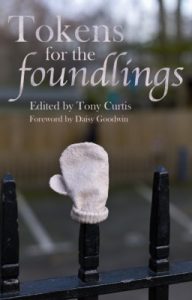
Tokens for the Foundlings is an anthology of poetry about childhood published for the benefit of the Foundlings Museum in London, with royalties paid to it. The museum, established by tradesman and ship owner Thomas Coram in 1739 with the support of Hogarth and Handel, was both the first orphanage in Britain and the first public art gallery. It has an ongoing programme of art exhibitions and other events, an educational programme and has an art collection which includes Hogarth and Gainsborough (another supporter) and a collection of manuscripts, books and libretti by Handel.
The book is divided into three sections concerning orphans and foundlings, infancy, and early childhood and include poems by Gillian Clarke, Carol Ann Duffy, Helen Dunmore, Stephen Knight, Don Paterson, Elaine Feinstein, Dannie Abse, Seamus Heaney, David Harsent, Carol Rumens, Kate Bingham, Michael Longley and George Szirtes among many other, all of whom have donated their work.
Childhood and parenting are enduring themes for poets and Tokens of the Foundlings offers a unique entry into these subjects through moving and beautiful poems. The foreword is by author and journalist Daisy Goodwin, and the book’s cover features a Foundlings museum artwork by Tracey Emin. This book is to be launched at the museum, and events are planned at a number of literary festivals around Britain.
www.foundlingmuseum.org.uk
Real South Pembrokeshire

Poet, and past resident and frequent visitor Tony Curtis roams south Pembrokeshire, from costal resorts of Tenby and Saundersfoot, west to the surfers of Stackpole and Barafundle and north to the Landsker, the cultural boundary between English speaking south Pembs and the Welsh speaking north. On his tour round half-county Curtis takes in many contrasts, from Pembrokshire’s famous new potatoes to the oil refineries of Angle, from farmworkers to immigrant artists, from the excited tourism of Folly Farm and Oakwood Park to the tranquillity of Bosherston Ponds and timeless beauty of Broadhaven beach.
In keeping with the series Curtis views his area through the eyes of a local and as a visitor, digging into his own Pembrokeshire backstory – and deeper into its history- but also observing keenly the Pembrokeshire of the new century. The mix of new and old, of memoir, anecdote and history gives us new insights into patters and the vivacity of life in one of the most beautiful places in Britain.
The Meaning of Apricot Sponge

“John Tripp and Dylan Thomas swam in the same sea. He may not have been as famous as his elder compatriot but in terms of volume his output was similar. He had a voice that was good on the ear, drank gallons, had the same kind of difficulties with money. ”
Peter Finch
John Tripp had a chameleon genius which enlivened the literary life of Wales for nearly three decades. Poet, short story writer and journalist, he was an outspoken and often controversial writer whose passion and vigour often spilled over the pages he wrote and into his life. Charming, abrasive, lyrical and satirical, The Meaning of Apricot Sponge is essential reading for anyone concerned with Wales and the roots of its contemporary identity. His wit and sharply observed social and political comments enriched debate, publications and broadcasts at that most crucial time in the struggle for self-rule in Wales.
The Meaning of Apricot Sponge is the first publication of Tripp’s work to represent his poetry, fiction, journalism and creative non-fiction. This is a generous, fully annotated selection across these genres with an illuminating Introduction by Tony Curtis and a Foreword by Peter Finch, two of Tripp’s friends and collaborators. Both writers also contribute poems dedicated to John Tripp.
Here at last in one volume is the opportunity to enjoy the depth and scope of an unforgettable character –
His art was blunt inside its shattering glove,
his spleen well thrust against a failure of the heart.
He offered no quarter to the grubbing merchants of cant.
and a remarkable writer –
Mark him, young poets in the city.
He has much to teach, against the clock,
packing beauty into the murk.
After the First Death: An Anthology
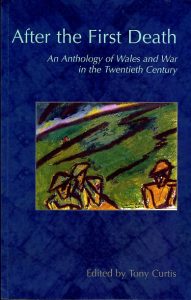
This anthology contains writing by many of the greatest authors of Wales. From Wilfred Owen and David Jones, Dylan Thomas and Dannie Abse to Christopher Meredith and Gillian Clarke, it spans a century which saw both the barbarism of mechanised warfare and the development of mass communication, mass literacy and a flourishing of creative endeavour.
After the First Death draws on the experience of those who have faced death on the battlefield, and on others who have sought to put into words the complex philosophical, political and emotional responses that military action demands. Including poetry, extracts from fiction, memoirs, letters and biography, the book moves from World War One via the ideological battleground of the 1930s into the Second World War, then through the Cold War, Vietnam, the Falklands and the Gulf wars.
Crossing Over

Tony Curtis’ wide-ranging interests in visual art, the impact of war and the nature of friendship coallese in his latest collection, “Crossing Over”. A number of the poems take their inspiration from great artists, from early religious icons to expressionist canvasses, from a ‘buttery girl’ in a Flemish Landscape to the chainsaw sculptures of David Nash. This book includes two thoughtful and beautiful war poems, including the title piece, a moving tribute to World War Two Veterans on a D-Day memorial excursion. There are also a series of sumptuous poems about travelling, including “Postcards from Tuscany” where the lush beauty of the landscape contrasts with the poet’s mood, saddened by the death of a friend. There are several succinct sonnets about California, on subjects as various as vagrants in San Francisco and the stunning cliff-face walls in Yosemite National Park. A sonnet about his granddaughter opens this varied and striking collection which shows a poet writing at the top of his game.
Wales at War: Critical Essays on Literature and Art
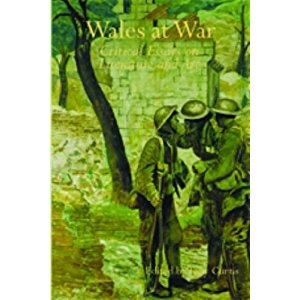
Great literature and art have been an unintended consequence of war. The writings and images of those caught up in conflict or reflecting on its experience are embedded in our national consciousness. Wales has played its part in British battles over the past century, and in “Wales at War”, its finest critics consider how, amidst the turmoil and trauma, creativity has flourished. From the trenches of the First World War came Wilfred Owen, Hedd Wyn, Edward Thomas, Robert Graves and David Jones. The ideological battles of the 1930s tested consciences and saw writers develop an overtly political message, particularly in support of the anti-fascist struggle in Spain. Dylan Thomas wrote propaganda and some of his finest poetry in response to war, while his contemporary Alun Lewis is celebrated as one of Britain’s finest writers, despite his early death in Burma. Away from the fighting, novelists like Lily Tobias, Sian James and Stevie Davies have written of life on the home front and the impact of war on the lives of those left behind. In the visual arts, conflict has informed the work of Augustus John, David Jones, John Piper, Ceri Richards, John Petts, Brenda Chamberlain and others. Art historian Eric Rowan offers an essay from the opposite direction: on how government and the art establishment want war commemorated by Welsh and other artists.
Anthologies
Tony has had poems published in a number of anthologies. Here are some of the most recent:
A Room to Live In (Salt)
Contourlines (Salt)
Another Country: Hauku from Wales (Gomer Press)
Evan Walters: Moments of Vision (Seren)
Thinking Continental ed. Lynch, Maher, Wall and Wltzien , (University of Nebraska Press).
Where the Birds Sing Our Names (Ty Hafan) Seren – available from www.tyhafan.org